
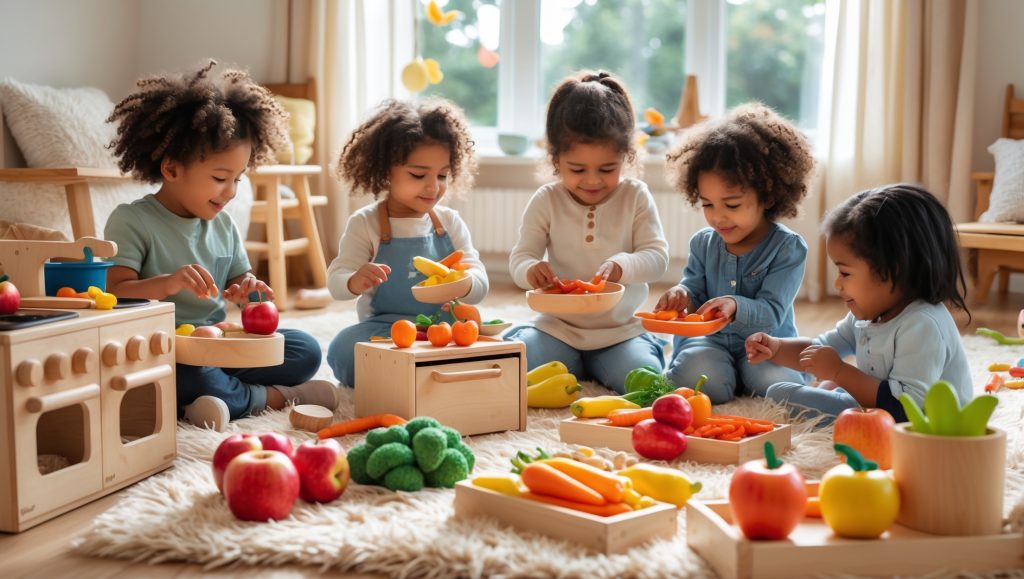
How We Chose
When selecting the best open-ended toys for food-themed play in 2025, we looked for products that encourage creativity, support healthy food relationships, and grow with your child. We prioritized toys made from safe, durable materials, suitable for different developmental stages, and backed by strong family reviews. Our list draws on current trends, expert recommendations, and real-world feedback from U.S. families.
1. Melissa & Doug Wooden Cutting Food Set — Classic Pretend Play
Why it stands out
This timeless set encourages hands-on learning about food, fine motor skills, and imaginative play. The “cutting” action with safe wooden knives and Velcro connects promotes coordination and food familiarity.
Best for
- Preschoolers exploring pretend meals
- Families seeking durable, classic toys
- Early lessons in food groups and kitchen skills
Key notes
- Age/Stage: 3+ years
- Materials/Ingredients: Sustainably sourced wood, non-toxic paints
- Strengths: Sturdy, reusable, encourages role play
- Trade-offs: Wooden pieces are heavier than plastic; Velcro may wear over time
2. Learning Resources New Sprouts Deluxe Market Set — Market & Meal Imagination
Why it stands out
With a variety of soft, colorful play foods, this set supports open-ended shopping, sorting, and meal-making scenarios. It’s great for solo or group play, helping kids make sense of real-world routines.
Best for
- Toddlers and preschoolers
- Playdates and sibling play
- Introducing food diversity
Key notes
- Age/Stage: 2–6 years
- Materials/Ingredients: Soft, BPA-free plastic
- Strengths: Safe for little hands, dishwasher-safe, lots of variety
- Trade-offs: Plastic can dent over time; not suitable for children who mouth toys
3. Hape Healthy Basics Wooden Kitchen Play Set — Realistic Food Prep
Why it stands out
This compact set features milk, juice, eggs, and other basics, all crafted from smooth wood. It invites conversations about nutrition and healthy choices while fostering imaginative cooking scenarios.
Best for
- Young chefs interested in food prep
- Parents wanting non-plastic toys
- Daycares and playrooms
Key notes
- Age/Stage: 3+ years
- Materials/Ingredients: Wood, water-based paint
- Strengths: Eco-friendly, tactile, simple design
- Trade-offs: Smaller number of pieces; some foods less recognizable to picky eaters
4. KidKraft Ultimate Corner Play Kitchen — Expansive Culinary Adventures
Why it stands out
This large, detailed kitchen offers a full range of pretend appliances, opening up endless role-play opportunities. Kids can “cook,” “wash,” and “store” their play food, practicing routines they see at home.
Best for
- Families with space for a larger toy
- Multiple children or group settings
- Long-term pretend play
Key notes
- Age/Stage: 3–8 years
- Materials/Ingredients: MDF, plastic, metal
- Strengths: Realistic features, encourages collaborative play, durable construction
- Trade-offs: Assembly required; larger footprint
5. Green Toys Tea Set — Eco-Friendly Social Play
Why it stands out
This cheerful tea set is made from recycled plastic and is food-safe for real snacks. It’s perfect for encouraging inclusive, imaginative gatherings and developing sharing skills.
Best for
- Tea parties and snack time role-play
- Eco-conscious families
- Indoor or outdoor play
Key notes
- Age/Stage: 2+ years
- Materials/Ingredients: 100% recycled plastic, dishwasher safe
- Strengths: Non-toxic, lightweight, easy to clean
- Trade-offs: Fewer food pieces included; some sets have pastel-only colorways
6. IKEA Duktig 14-Piece Vegetable Set — Soft, Safe, and Colorful
Why it stands out
These plush vegetables invite safe, hands-on exploration and gentle food exposure for younger children. The soft construction makes them great for sensory play and early food discussions.
Best for
- Infants and toddlers
- Children who enjoy sensory play
- Introducing produce variety
Key notes
- Age/Stage: 18 months+
- Materials/Ingredients: Polyester fabric, filling
- Strengths: Machine washable, lightweight, gentle on gums
- Trade-offs: Not suitable for mouthing if seams wear; no hard cutting action
7. Tender Leaf Toys Fruity Basket — Beautiful, Heirloom-Quality Fruits
Why it stands out
Cleverly crafted wooden fruits in a woven basket encourage sorting, counting, and pretend grocery shopping. The design offers lasting appeal and supports multiple forms of open-ended play.
Best for
- Gift-giving
- Families seeking visually appealing toys
- Montessori-inspired playrooms
Key notes
- Age/Stage: 3+ years
- Materials/Ingredients: Rubberwood, non-toxic finishes
- Strengths: Aesthetically pleasing, sturdy, supports learning through play
- Trade-offs: Higher price point for size; basket may fray with heavy use
8. PlanToys Wooden Bread Set — Interactive Baking Fun
Why it stands out
This set lets children “slice” and assemble different breads and pastries, encouraging both fine motor skills and discussions about food variety. The pieces are smooth and sized for small hands.
Best for
- Budding bakers
- Hands-on learners
- Families valuing sustainable materials
Key notes
- Age/Stage: 2+ years
- Materials/Ingredients: PlanWood (reclaimed rubberwood, organic pigments)
- Strengths: Eco-friendly, tactile, easy to clean
- Trade-offs: May be limited to bread/bakery play; fewer food group options
9. Guidecraft Grippies Builders — Sensory Construction with Food Shapes
Why it stands out
While not traditional play food, Grippies Builders allow children to create their own pretend food with magnetic, textured rods and balls. They support sensory exploration and imaginative food construction.
Best for
- Children who love to build
- Families seeking STEM-inspired food play
- Kids who enjoy sensory textures
Key notes
- Age/Stage: 18 months–5 years
- Materials/Ingredients: ABS plastic, internal magnets
- Strengths: Open-ended, easy to clean, encourages creativity
- Trade-offs: Pieces can be lost; not focused solely on food realism
Buying Tips
When choosing open-ended toys for food-themed play, consider your child’s interests, play space, and developmental stage. Look for toys made from safe, non-toxic materials and check for age-appropriate designs—especially for infants and toddlers. Sets with a variety of foods support broader learning, while fewer, high-quality pieces may be more durable over time. If sustainability matters to your family, seek out eco-friendly brands. Observe how your child engages: some kids prefer realistic play food, while others enjoy abstract building sets.
Verdict
Open-ended toys that center around food play remain a favorite in 2025 for nurturing creativity, social skills, and positive attitudes toward food. Whether you choose a classic wooden set, a plush basket of produce, or a modular building kit, these toys offer long-lasting, screen-free engagement for a range of ages. By selecting thoughtfully, you can encourage learning, sharing, and fun in your family’s daily routines.
FAQ
+Are open-ended food toys safe for all ages?
+How do food-themed toys support healthy eating habits?
+What’s the difference between open-ended and structured play food toys?
+Can these toys help with picky eating?
+How can I clean and maintain play food sets?
+Are eco-friendly play food toys worth the investment?
+What are some ways to extend play with these toys?
+Can older kids still enjoy food-themed pretend play?

Open-ended toys are essential for fueling children’s creativity and cognitive growth, especially in the context of food-themed play. The right toys invite kids to imagine, role-play, and invent stories around everyday experiences like cooking, shopping, and sharing meals. In 2025, the market is brimming with thoughtfully designed, durable playsets that go beyond mere plastic food. From wooden market stalls to magnetic sandwich makers, these toys encourage social skills, language development, and even early math concepts. Parents should look for versatile sets with mix-and-match components, realistic textures, and multicultural food items to spark curiosity about global cuisines. Open-ended food play not only entertains but also builds empathy as children “serve” others and collaborate in pretend kitchens. Whether your child dreams of running a bakery, hosting a picnic, or exploring new recipes, these top nine picks for food-themed imaginative play are sure to inspire hours of joyful, screen-free engagement. Investing in quality, open-ended toys is investing in your child’s ability to invent, problem-solve, and connect with the world around them.
- Encourages language, math, and social skills through pretend play
- Promotes cultural awareness with diverse food options
- Supports creativity and independent thinking
- Durable designs made for years of imaginative use
We have limited space at home, so I wonder which of these options would work best for a smaller play area without feeling cluttered or overwhelming for a sensory-sensitive toddler.
It’s great that you’re being mindful of both space and your toddler’s sensory needs. Try choosing one or two compact sets, like soft felt play foods or a small wooden tea set, as these can spark imagination without taking up much room. Store pieces in a shallow bin or basket for easy access and cleanup. Avoid toys with lots of tiny parts or strong scents if your toddler is sensory-sensitive. Keep the play area calm and uncluttered by rotating toys weekly. This isn’t medical advice; if you have concerns about your child’s sensory preferences, check in with your pediatrician.
I’ve noticed some of these toys are plastic while others are wooden. For a 10-month-old who still mouths toys and sometimes throws things, which material is safer and easier to clean after messy mealtime play sessions?
You’re wise to think about safety and clean-up when choosing toys for your 10-month-old. At this age, babies often put toys in their mouths and drop or throw them. Generally, sturdy plastic toys without small parts are easier to sanitize thoroughly after messy play. Look for BPA-free, phthalate-free options. Wooden toys can be safe if they have smooth finishes and non-toxic paints, but moisture can cause warping or make cleaning tougher. Always supervise play, especially with any small parts. This isn’t medical advice; if you’re concerned, check in with your pediatrician.
My toddler’s interest in pretend food play seems to interfere with following a consistent potty schedule. Do you have tips for balancing open-ended play with staying on track during potty training, or should I rotate these toys in and out during this time?
It’s understandable to want your toddler to enjoy pretend food play while also keeping potty training on track. Try setting a timer for regular potty breaks, and gently pause play when it rings. Offer a quick reminder before play starts about when the next potty trip will be. You can also use pretend food play as a fun reward after a successful potty visit. Rotating toys is fine if it feels overwhelming, but with supervision and gentle reminders, most toddlers can balance both. This isn’t medical advice; if you’re concerned, check in with your pediatrician.
We live in a small apartment, so space is tight and storage is a struggle. Out of the top picks you mention, which ones are easiest to store or pack away when one of my twins is sleeping?
You’re thoughtful to consider space and your twins’ routines. For compact storage, soft play food sets or felt food can be packed into a small bin or bag and quickly stashed away. Stackable plastic food sets also fit easily into drawers. Wooden cutting food sets often come in their own box for easy clean-up and storage. Avoid larger kitchen playsets if you’re tight on space. Always check for age-appropriate pieces—choose bigger items for toddlers to avoid choking hazards, and supervise play. This isn’t medical advice; if you’re concerned, check in with your pediatrician.
My toddler still occasionally puts toys in their mouth, and I see some sets aren’t recommended for children who mouth toys. Is there a reason why wooden toys might pose more or less of a safety concern in this case compared to soft plastic?
It’s completely normal to be cautious when your toddler still mouths toys. Wooden toys can sometimes splinter if damaged, and the paints or finishes may not always be food-grade, which is a concern for mouthing children. Soft plastic toys designed for young toddlers are usually made to withstand chewing and are less likely to break into sharp pieces. Whichever material you choose, always check for age recommendations, avoid toys with small detachable parts, and supervise play. This isn’t medical advice; if you’re concerned, check in with your pediatrician.
My toddler is sensitive to different textures and sometimes avoids hard or rough materials. Do you think the wooden food sets or the soft plastic items from Learning Resources are better suited for a kid with some mild sensory sensitivities?
It’s completely understandable to want toys that feel comfortable for your toddler’s sensory needs. For children with mild sensitivities to hard or rough textures, soft plastic food toys from Learning Resources are often a gentler option—they tend to be smoother and less likely to cause discomfort than unfinished or chunky wooden sets. Try introducing one or two pieces first, watching your child’s reactions, and always supervise play with any small parts. If your child seems open, you can gradually explore wooden toys with smoother finishes. This isn’t medical advice; if you’re concerned, check in with your pediatrician.
I’m curious whether families with younger siblings let both a 2-year-old and a preschooler play with these sets together, especially since a lot are labeled 3+. Do you have tips for safely including younger kids in pretend kitchen play?
It’s great that you want both your 2-year-old and preschooler to enjoy pretend kitchen play together. For safety, supervise closely and remove any small, detachable pieces that could be a choking hazard for younger siblings. Choose larger, softer food toys and utensils made from non-toxic materials. Introduce simple kitchen roles, like stirring or sorting foods, so your toddler participates without handling complex items. Always check for sharp edges or breakable parts before play. This isn’t medical advice; if you’re concerned, check in with your pediatrician.
With so many baby foods on the market, is there a significant difference in how much iron babies usually get from cereals compared to pureed options? Would love your expert take on how parents can best meet those nutritional needs.
It’s great that you’re thinking carefully about your baby’s iron needs. Iron-fortified cereals generally contain more iron per serving than many pureed fruits or veggies, which are often low in iron unless they’re specifically fortified or contain meat. To support healthy iron intake: 1) Start with iron-fortified cereals around 6 months, as recommended, if your pediatrician agrees. 2) Gradually add pureed meats or legumes, which are also good iron sources. 3) Pair plant-based iron foods with vitamin C-rich options to boost absorption. 4) Always supervise mealtimes and choose age-appropriate textures to prevent choking. This isn’t medical advice; if you’re concerned, check in with your pediatrician.
My daughter just turned two and still tends to put toys in her mouth sometimes. For the Learning Resources New Sprouts Deluxe Market Set, how concerned should I be if she tries to chew on the plastic pieces? Are there better open-ended food play options for this age that are completely safe in case of mouthing?
It’s completely normal for two-year-olds to mouth toys as they explore their world. The Learning Resources New Sprouts Deluxe Market Set is designed for toddlers, so the pieces are larger and generally free of small choking hazards, but supervision is still important to prevent accidental swallowing or chewing off small parts. Wash new toys before play, and regularly check for wear or cracks. For children who mouth toys, consider soft play food made from silicone or cloth, which can be easier on gums and safer if mouthed. This isn’t medical advice; if you’re concerned about safety, check in with your pediatrician.
I noticed several sets mention suitable ages, but my child is 4 and sometimes gravitates toward toys labeled for slightly younger or older kids. How much should I stick to manufacturer age guidance for things like the wooden kitchen or market set, especially if they seem interested but not quite at the recommended age?
It’s great that you’re paying attention to your child’s interests and safety. Manufacturer age guidelines are helpful for flagging small parts, sharp edges, or pieces that could be a choking hazard, especially for kids under 3. For a 4-year-old, wooden kitchen or market sets are usually safe with supervision, but double-check for loose parts or accessories they might mouth. If your child seems ready for a more advanced set, stay nearby to guide play and help with tricky pieces. Always trust your judgment—you know your child best. This isn’t medical advice; if you’re concerned, check in with your pediatrician.
I’m interested in the Learning Resources New Sprouts set because it seems good for group play. If my 4-year-old easily gets overstimulated during noisy playdates, do you have tips for making food-themed pretend play more peaceful and manageable for her?
It’s wonderful that you want to support your child’s enjoyment while being mindful of her sensory needs. Try setting up a smaller play area slightly apart from the main group, so she has a quieter space. Offer the food-themed toys in smaller batches to reduce visual and tactile clutter. Let her know it’s okay to take breaks if things get loud or overwhelming. You might also model gentle play, like soft voices and turn-taking, to set the tone. Always supervise closely at this age to ensure safe and respectful play. This isn’t medical advice; if you’re concerned, check in with your pediatrician.
Our play space is limited, but we want to encourage group play and language skills. Would you recommend prioritizing a large kitchen set like the KidKraft if we have siblings, or should we stick to a basic set like Hape’s and rotate toys more often?
It’s wonderful that you’re thinking about group play and language development in your limited space. If room is tight, a smaller set like Hape’s can still encourage collaborative play among siblings—especially if you rotate in related accessories or play food to keep things fresh. Arrange the toys so everyone can access and share items, and prompt conversation by inviting kids to take turns or act out roles. Always check for age-appropriate pieces, especially with younger siblings who might mouth small parts. This isn’t medical advice; if you’re concerned, check in with your pediatrician.
I noticed the Hape Healthy Basics set has fewer pieces compared to some others. For a highly active toddler who gets bored quickly, do you find sets with more variety help extend their playtime, or can fewer pieces still hold their attention?
It’s understandable to want toys that truly engage your active toddler. While more pieces can provide extra variety and options, even smaller sets like the Hape Healthy Basics can spark rich pretend play if you rotate toys in and out, join in their play for new ideas, and encourage mixing the set with real (safe) kitchen items. For toddlers, fewer pieces can sometimes prevent overwhelm and make cleanup easier, but supervision is important with any small parts. Try observing how your child interacts with both larger and smaller sets to see what keeps them engaged. This isn’t medical advice; if you’re concerned, check in with your pediatrician.
If my child still mouths toys from time to time, would you recommend waiting before introducing the Learning Resources New Sprouts set, or are there workarounds to keep play safe at this stage?
It’s very normal to worry about toy safety when your child still mouths objects. With the Learning Resources New Sprouts set, check that all pieces are large enough not to be a choking risk and made from non-toxic, BPA-free materials. Supervise play closely and remove any pieces that seem too small for your child’s age or could fit in their mouth. You might also set aside the most tempting items until mouthing decreases and offer similar food-themed toys designed for young toddlers instead. This isn’t medical advice; if you’re concerned, check in with your pediatrician.
For families in smaller apartments, which of these food-themed toys would you recommend as the easiest to store away when not in use? I worry about clutter but still want a set that encourages plenty of pretend play.
It’s completely understandable to want toys that inspire creativity without adding clutter to a small space. From the list, soft felt food sets or stackable wooden play foods are great choices—they’re lightweight, compact, and easy to tuck away in a bin or drawer. Magnetic food sets often come in their own box, which helps with organization. Avoid larger kitchen playsets or toys with lots of loose, tiny pieces. Always ensure pieces are safe for your child’s age to prevent choking hazards. This isn’t medical advice; if you’re concerned, check in with your pediatrician.
For a 9-month-old just starting to explore food allergens, would any of these pretend food sets be suitable for supervised sensory play? Most recommendations seem to be for older toddlers, so I am wondering if there are tips for adapting these toys for younger babies or if I should wait until age 1.
It’s great that you’re thinking about safe ways to introduce sensory play as your baby explores new foods. At 9 months, most pretend food sets are designed for older toddlers and may have small parts or harder textures, so safety is a top concern. If you want to adapt, choose only large, soft, easy-to-clean pieces—avoid anything that could be a choking hazard. Always supervise closely and inspect toys before play. For now, you might also create your own sensory experiences using safe kitchen items or homemade textured foods. This isn’t medical advice; if you have concerns about allergens or safety, check in with your pediatrician.
My child tends to be sensitive to certain textures. Are there play food sets on your list that are especially good for kids with sensory preferences or who avoid rough or hard materials?
It’s great that you’re thinking about your child’s sensory comfort during play. For kids sensitive to textures, consider soft felt play food or smooth wooden pieces from the list—these materials are often gentler on hands than plastic or rough fabrics. Let your child touch different materials before play and observe their reactions, introducing new textures slowly. Always supervise young children with small parts to ensure safety. You might also involve your child in selecting new toys, so they feel in control. This isn’t medical advice; if you’re concerned, check in with your pediatrician.
My child is very sensitive to noise and gets overstimulated easily in the evenings. Are there suggestions in your list for food-themed toys that support calm, quieter play before bed?
It’s wonderful that you’re looking for calming play options for your child’s sensitive moments. For quieter, soothing food-themed play, consider soft felt food sets or plush fruit and veggie toys from our list—these are gentle to the touch and encourage slow-paced, imaginative play. Wooden play food with smooth edges (avoid sets with clattering parts or loud Velcro) can also be arranged or ‘cooked’ in a relaxed way. Try setting up a pretend picnic with dim lights or a quiet tea party, keeping pieces manageable and avoiding small parts if your child is very young. This isn’t medical advice; if you’re concerned, check in with your pediatrician.
My daughter is 16 months and tends to put everything in her mouth, especially when she is playing. I noticed that some of the recommended sets use wood or plastic. Are there any options from your list that are specifically safe for kids who still mouth their toys?
It’s very normal for toddlers to explore with their mouths at this age. For a 16-month-old, focus on food-themed toys that are large, single pieces without small parts—look for sets labeled for 12 months and up. Solid wood food pieces with non-toxic, water-based paints are generally safe if they don’t have removable parts, while some silicone play food is also suitable and easy to clean. Always supervise during play and avoid any sets with velcro, magnets, or detachable accessories. This isn’t medical advice; if you’re concerned, check in with your pediatrician.
Since potty training often comes with changes in routines and accidents, I’m thinking about durability and easy cleaning. Would the soft plastic foods from the Learning Resources set be simple to sanitize if my toddler has a bathroom accident during play?
It’s completely understandable to prioritize easy cleaning during potty training. The soft plastic foods from Learning Resources are generally designed to withstand frequent wiping and even a gentle wash. After any accident, rinse the toys with warm, soapy water, then let them air dry thoroughly. For extra sanitation, you can wipe them down with a diluted bleach solution (1 tablespoon bleach per gallon of water), but always rinse well afterward to avoid residue. These toys are typically one piece with no small crevices, making them fairly straightforward to clean, but always inspect for any trapped moisture or dirt. This isn’t medical advice; if you’re concerned, check in with your pediatrician.
As someone about to send my little one to daycare, I am wondering how these food play toys fit into the typical daycare routine for 1-year-olds. Is there a certain time of day that’s best for introducing pretend food play, or do daycares usually leave them out during free play?
It’s completely natural to wonder how your child will interact with play food toys in a new daycare setting. Most daycares for 1-year-olds incorporate pretend food toys during supervised free play, letting children explore them at their own pace. If you’d like to introduce these toys at home, try short, unhurried play sessions after meals or during morning routines, when your little one is well-rested. Always check that the toys are age-appropriate—large enough to avoid choking hazards and made of safe materials. This isn’t medical advice; if you’re concerned, check in with your pediatrician.
Do you have any recommendations for adapting these food play sets for a toddler who has some sensory sensitivities, particularly with different textures or materials? I want to encourage imaginative play but also need to avoid anything that might overwhelm my child.
It’s wonderful that you want to support your toddler’s sensory needs while encouraging imaginative play. Start by choosing play food sets made from one uniform, soft material like smooth wood or silicone, avoiding mixed textures or fuzzy fabrics. Introduce new items slowly, letting your child explore each piece at their own pace. Wash and inspect toys for any strong smells or rough edges before play. Offer a consistent, quiet play space to reduce sensory overload, and always stay nearby for gentle guidance. This isn’t medical advice; if you’re concerned, check in with your pediatrician.
We live in an apartment with limited space, so I’m hesitant about getting a big play kitchen like the KidKraft Ultimate Corner Play Kitchen. Do you have suggestions for smaller, food-themed play sets that can still support open-ended imaginative play for a preschooler?
It’s understandable to want fun play options that fit a smaller living space. You might try compact wooden food sets, felt food kits, or stackable baskets of play produce, which allow for pretend cooking, shopping, and restaurant games without taking up much room. A sturdy tray or small tabletop grill can double as a kitchen when placed on the floor or table. Choose pieces that are large enough to avoid choking hazards and easy to clean, especially for preschoolers. Always supervise young children with play food. This isn’t medical advice; if you’re concerned, check in with your pediatrician.
How do the durability and lifespan of the wooden options compare to the plastic sets when it comes to daily use by an active preschooler? I’m trying to decide which would last longer for my child.
It’s great that you’re thinking about longevity and sturdiness for your preschooler’s playthings. Generally, high-quality wooden food toys tend to withstand rough daily play better than many plastic sets—they resist cracks and dents but can show paint wear or splinter if not well-made. Plastic sets are often lighter and may scratch or crack over time, but they’re usually washable and less likely to chip. For both options, check for smooth edges, secure paint, and non-toxic finishes, and supervise play—especially for small parts. This isn’t medical advice; if you’re concerned, check in with your pediatrician.
We live in a small apartment and space is tight. How do the play kitchen sets compare in terms of storage or being able to pack them away when not in use? Do you have any tips for keeping these toys organized?
It’s completely understandable to want play kitchen toys that fit a smaller space and can be stored easily. Many modern play kitchen sets are designed with compact living in mind—look for foldable or tabletop versions that can slide under a bed or into a closet. Choose sets with stackable food pieces or those that come with their own storage bins. You might also use a clear container or lidded basket to keep play food and utensils together. Remind your child to help tidy up as part of play, making clean-up a fun routine. Always check that small parts are kept out of reach if you have babies or toddlers. This isn’t medical advice; if you’re concerned, check in with your pediatrician.
Do you have any tips for storing larger play kitchens like the KidKraft one, especially in smaller living spaces? I want to encourage pretend food play later on, but I am worried about finding room as my baby grows.
It’s completely understandable to want to nurture pretend play while still keeping your living space manageable. Consider placing the play kitchen against a wall or in a corner to maximize floor space. Use bins or baskets inside the play kitchen itself to store pretend food and utensils, keeping everything together and tidy. If possible, choose a model with built-in shelves or hooks for extra storage. For smaller homes, look for foldable or compact designs that can be tucked away when not in use. Always check for stability and secure heavy pieces to the wall if your child is under three. This isn’t medical advice; if you’re concerned, check in with your pediatrician.
If my child has some sensory aversions to certain textures, like the soft plastic foods in the Learning Resources set, are there strategies for introducing these items gradually during rotation or ways to encourage acceptance through play?
It’s understandable to want your child to feel comfortable exploring new textures during play. Start by placing the less-preferred toy near your child without expectation, letting them observe it at their own pace. Gradually involve the toy in their favorite pretend games, using familiar accessories or foods as a bridge. Offer praise for any interaction, even if it’s just touching or moving the toy. If your child is very young, supervise closely to ensure safety, especially with small parts or materials they may mouth. Always let your child lead the pace, and if aversions persist or cause distress, consider consulting your pediatrician or an occupational therapist. This isn’t medical advice; if you’re concerned, check in with your pediatrician.
If my baby tends to get overwhelmed by bright colors or lots of noise, which of the recommended food play sets would be best for a calmer sensory experience for someone under a year old?
It’s great that you’re noticing your baby’s sensory preferences and want to create a soothing play experience. For a baby under one year old who gets overwhelmed by bright colors or noise, I recommend choosing the soft cloth food sets or wooden food toys from the article, as these are usually quieter and feature gentler, natural tones. Look for sets with larger pieces to avoid choking hazards and avoid sets with small detachable parts. Always supervise play at this age and wash toys regularly to keep them safe for mouthing. This isn’t medical advice; if you’re concerned, check in with your pediatrician.
If a child tends to have sensory sensitivities, especially with different textures, how do the materials of the Learning Resources New Sprouts Market set compare to the wooden sets? Is one more likely to be well-tolerated for kids who are sensitive to touch?
You’re right to consider texture for a sensory-sensitive child. The Learning Resources New Sprouts Market set uses soft, slightly squishy plastic that feels smooth and gentle in hand, while wooden sets tend to be firmer, sometimes with natural grain or paint texture. For many sensory-sensitive children, the smooth plastic may be less overwhelming than the varied feel of wood. I suggest letting your child touch both types briefly before introducing a full set, observing their comfort. Always supervise play, check for small parts, and clean toys regularly to prevent irritation. This isn’t medical advice; if you’re concerned, check in with your pediatrician.
My kid is easily overwhelmed by crowded or very colorful toys. Are there any options from your list that are simpler in design or calmer in appearance, which might help make sensory play a bit less intense for sensitive toddlers?
It’s great that you’re tuning in to your child’s sensory needs. From the list, consider wooden food sets or felt play food—these tend to have muted colors, smooth textures, and simple designs, which can feel less overwhelming. Choose sets with fewer pieces to keep play manageable. Lay out just a few items at a time and play together to support your toddler’s comfort. Always check for small parts and make sure toys are age-appropriate and non-toxic. This isn’t medical advice; if you’re concerned, check in with your pediatrician.
My child sometimes prefers puree pouches over cereal but I want to make sure they’re getting enough iron. Have you found that playing with food sets like these encourages tasting new foods or just reinforces favorites?
It’s great that you’re attentive to your child’s nutrition and open to trying new strategies. Food-themed play sets can gently encourage curiosity about different foods, especially if you model pretending to taste or talk about a variety of foods during play. Try introducing toy versions of iron-rich foods, then pair the play with real-life tasting opportunities in a low-pressure way. Keep mealtimes positive and let your child explore textures and smells without pressure to eat. For young children, ensure toys are free from small parts and safe materials. This isn’t medical advice; if you’re concerned about iron intake, check in with your pediatrician.
My child is quite sensitive to certain textures, especially sticky or rough ones. Are any of the recommended sets particularly good for children with sensory sensitivities, or are there materials to avoid?
It’s great that you’re considering your child’s sensory needs while choosing toys. For children sensitive to textures, look for sets made from smooth, solid wood or soft, food-grade silicone, as these are usually gentle to the touch and less likely to trigger discomfort. Avoid toys with fuzzy, sticky, or rough surfaces, as well as those with small parts that could be hard to clean. Always check for age-appropriate labeling and supervise during play to ensure safety. This isn’t medical advice; if you’re concerned, check in with your pediatrician.
My child is very sensitive to different textures and sometimes refuses to touch certain materials. Are any of these food-themed toys better for children who might be particular about how things feel?
It’s understandable to want toys that respect your child’s sensory sensitivities. From the article, wooden and silicone food-themed toys tend to have smoother, more predictable textures and are often well-tolerated by children who are particular about touch. Choose toys without fuzzy, sticky, or squishy parts and start with just one new texture at a time. Let your child explore at their own pace, maybe using a spoon or tongs instead of hands at first. Always supervise closely, especially if your child is young or tends to mouth objects. This isn’t medical advice; if you’re concerned, check in with your pediatrician.
For families with a wide age range of kids, is it best to wait until all children are past the mouthing stage before introducing more realistic or smaller food toys, or can you recommend safe ways to supervise mixed-age food-themed play?
It’s thoughtful to consider safety for all ages when choosing food-themed toys. If you have children still in the mouthing stage, select larger, chew-safe pieces without small parts, and closely supervise play with older siblings. Create designated play times when older kids use smaller or more realistic toys, and store these out of reach when not in use. Offer babies their own safe alternatives nearby so they feel included. Always check toys for age recommendations and choking hazards. This isn’t medical advice; if you’re concerned, check in with your pediatrician.
How do you recommend introducing these food-themed toys to children who tend to mouth everything, especially for families still dealing with nap transitions and needing extra supervision during playtime?
It’s completely understandable to be cautious when introducing new toys to little ones who often mouth objects, especially during nap transitions when supervision might fluctuate. Start by choosing larger, solid food-themed toys without small parts or loose pieces, and avoid anything with removable stickers or fuzzy textures that could pose a choking risk. Always supervise closely during play, keeping sessions short and engaging so you can monitor them easily. Clean toys regularly to remove germs, since mouthing is frequent at this age. Rotate toys to keep things fresh, and offer them only when you can give your full attention. This isn’t medical advice; if you have concerns about safety or development, it’s always wise to check in with your pediatrician.
My child is pretty sensitive to loud or scratchy sounds. Are any of the toys you listed especially quiet or gentle for little ones who are bothered by the ripping noise Velcro sometimes makes when pieces are pulled apart?
It’s completely understandable to want toys that won’t bother your child’s sensitivity to sounds. From the article, felt food sets and wooden play foods are great choices—they’re naturally soft, quiet, and don’t use Velcro or snaps. Avoid plastic play foods with detachable parts that might click or pop apart. When introducing a new toy, supervise early play to make sure the texture and sound are comfortable for your child. Every child is different, so gentle, safe materials are a good starting point. This isn’t medical advice; if you’re concerned, check in with your pediatrician.
Sometimes my child has trouble with sensory sensitivities, especially when it comes to textures like Velcro or certain plastics. Do any of the recommended toy sets avoid those materials, or do you have tips for introducing these types of textures through food-themed play?
It’s completely understandable to want to support your child’s sensory sensitivities during play. In the article, several food-themed toys are made from smooth wood or soft fabric, avoiding Velcro and rigid plastics—these could be a gentler starting point. To introduce new textures, try letting your child explore them with their hands first, at their own pace, and without pressure. You might also set up a sensory bin with familiar and new textures side by side so your child can compare. Always supervise closely and check for small parts, especially for younger ages. This isn’t medical advice; if you’re concerned, check in with your pediatrician.
With sensory sensitivities, my child tends to avoid certain textures. Are there noticeable tactile differences between wooden and plastic play foods that might influence what kids gravitate toward or avoid during pretend play?
It’s understandable to want to make play comfortable for your child with sensory sensitivities. Wooden play foods usually feel smoother, firmer, and a bit heavier, while plastic versions can be lighter, cooler to the touch, and sometimes have more varied textures. To help your child, you might let them explore a few sample pieces before committing to a full set, observe their reactions, and gradually introduce new textures as tolerated. Always supervise young children, especially with smaller pieces. This isn’t medical advice; if you’re concerned, check in with your pediatrician.
Some food-themed play sets can have surprisingly tiny parts, like pretend eggs or Velcro pieces. Do you have any advice for families on how to safely introduce these toys or determine if their child is ready?
It’s wise to be cautious about small parts with food-themed play sets. First, always check the manufacturer’s age recommendation and inspect the set for choking hazards before use. For toddlers under 3, avoid sets with pieces smaller than a golf ball. Supervise play closely, especially with younger children or siblings nearby. Teach your child not to put toys in their mouth, and store small items out of reach when not in use. Safety always comes first—if you have concerns about your child’s readiness or development, this isn’t medical advice; check in with your pediatrician.
Can you clarify if these sets are appropriate for mixed-age siblings to use together? For example, are there any small parts or features that would require extra supervision if I have both a toddler and a preschooler at home?
It’s great that you’re thinking about safety for both your toddler and preschooler during play. Most open-ended food-themed sets on our list are designed with sturdy pieces, but some do include small parts such as pretend utensils or tiny food items. For mixed-age siblings, supervise closely when toddlers are involved and remove any pieces that could be choking hazards. Choose larger, easy-to-grip items for your youngest, and keep an eye on how both children interact with the toys together. Always check the manufacturer’s age guidelines before introducing new sets. This isn’t medical advice; if you’re concerned, check in with your pediatrician.
My child still sometimes mouths toys, even though they’re almost three. Would you recommend waiting a bit longer before introducing the Learning Resources New Sprouts Deluxe Market Set, or are there safer alternatives from your list for younger toddlers?
It’s completely normal to be cautious when your almost-three-year-old still mouths toys. The Learning Resources New Sprouts Deluxe Market Set is generally designed for ages two and up, but since it has small parts, close supervision is essential if your child tends to mouth objects. For now, consider safer alternatives from the article like the soft felt play food or chunky wooden food sets, which are typically larger and less likely to pose a choking hazard. Always check recommended age ranges and inspect toys for loose parts. This isn’t medical advice; if you’re concerned, check in with your pediatrician.
My preschooler sometimes becomes fixated on only a few foods in real life. Do you have recommendations for using these playsets, like the Hape Healthy Basics Set, to gently encourage curiosity about new foods during pretend play without pressuring them?
It’s very normal to want to help your preschooler feel comfortable exploring new foods. Try setting up pretend picnics or restaurant games with the Hape Healthy Basics Set, letting your child ‘prepare’ and ‘serve’ foods at their own pace. Gently introduce new play foods alongside old favorites—no pressure to taste or touch, just notice and name together. You can model curiosity by pretending to try a new food yourself and describing its shape, color, or pretend taste. Always supervise play to ensure small parts are safe for your child’s age. This isn’t medical advice; if you’re concerned, check in with your pediatrician.
My child still mouths toys occasionally, and I see you mention that the Learning Resources Market Set isn’t ideal for this. Are there other food-themed playsets from your list that would be better suited for kids in this stage?
It’s great that you’re thinking about safety while supporting your child’s play. For children who still mouth toys, look for food-themed sets made from larger, solid pieces without small detachable parts. From the article, the Green Toys Tea Set and PlanToys Fruit & Veggie Sets are good options—they use non-toxic materials, have chunky shapes, and are easy to clean. Always supervise play at this stage and regularly check for wear. This isn’t medical advice; if you’re concerned, check in with your pediatrician.
We sometimes notice our child is more interested in pretend food play after visiting grandparents who cook traditional dishes. How can we use these toys to help bridge conversations about healthy eating and respecting family food traditions?
It’s wonderful that you want to connect healthy eating with family traditions through pretend play. Try setting up a play kitchen with open-ended food toys that resemble your family’s traditional dishes. Invite your child to ‘cook’ together and talk about which ingredients are healthy and how they’re used in real meals. Ask your child to share their own recipes or memories from visits with grandparents. You can also encourage role-play, letting your child take turns being chef or customer, to practice respectful conversation about food choices. Make sure all toy pieces are safe and age-appropriate, especially for younger children. This isn’t medical advice; if you’re concerned, check in with your pediatrician.
Do you have advice for parents who prefer to purchase specific food-themed play sets but worry about outgrowing the toys too quickly? Are there particular sets that tend to stay engaging for children longer, or would a rotating subscription help keep things fresh?
It’s thoughtful to want toys that grow with your child while supporting imaginative play. Look for food-themed sets with mix-and-match pieces, varied textures, or accessories that fit a wide age range, like wooden play food with velcro or felt sets for pretend cooking. Choosing sets that encourage role-play (such as play kitchens or market stalls) often keeps children interested as their skills develop. For toddlers, ensure all pieces are large enough to avoid choking hazards. Rotating or swapping toys—whether through a subscription or with friends—can also refresh play without needing constant new purchases. This isn’t medical advice; if you’re concerned, check in with your pediatrician.
Since accidents are common with potty training, I worry about wooden food toys getting wet or stained. Is the Learning Resources New Sprouts Deluxe Market Set less likely to have issues with messes compared to the wooden options you mentioned?
It’s completely understandable to want toys that can handle the inevitable messes of potty training. The Learning Resources New Sprouts Deluxe Market Set is made from durable plastic, which is generally much easier to clean and sanitize than wooden toys—simply wash with warm, soapy water and let them air dry. Wooden toys can absorb moisture and may stain or warp if they get wet, so they’re best kept away from damp play areas for toddlers still mastering potty skills. Always supervise play to ensure safety. This isn’t medical advice; if you’re concerned, check in with your pediatrician.
My toddler has some speech delays and often just lines up play food instead of pretending to eat or cook. Do you have any suggestions for using sets like the Melissa & Doug or Learning Resources food toys to encourage more social or language-rich play during our routines?
It’s wonderful that you’re looking for ways to support your toddler’s language through play. Try narrating what you’re doing with the play food—describe colors, shapes, and pretend actions like ‘cutting’ or ‘mixing.’ Join your child and model simple pretend scenarios, such as ‘Let’s make soup together’ or ‘Can you feed the teddy bear?’ Offer choices (‘Do you want the apple or banana?’) to encourage responses. For toddlers, keep sessions short and relaxed, letting them take the lead. Always supervise closely to ensure safety with small parts. This isn’t medical advice; if you’re concerned, check in with your pediatrician.
When you mention that the Learning Resources New Sprouts Deluxe Market Set is not suitable for children who mouth toys, does that mean it’s a choking hazard or just that it’s not intended to be chewed on? I sometimes watch a toddler who still mouths objects occasionally, so I want to be sure it’s safe.
You’re right to be cautious about toy safety for toddlers who still mouth objects. The Learning Resources New Sprouts Deluxe Market Set contains small food pieces that could pose a choking hazard for young children, especially those under 3 or who are still mouthing. If you’re supervising a toddler who mouths toys, it’s safest to wait until they’ve outgrown this stage or stick with larger, one-piece play food intended for infants and young toddlers. Always supervise play, and check the packaging for recommended ages and safety warnings. This isn’t medical advice; if you’re concerned, check in with your pediatrician.
My baby gets a bit overwhelmed by loud or hard textures, so I’m curious whether any of these sets focus more on soft materials or have gentler sensory options. Is there a toy on this list that would suit a baby who is sensitive to touch or sound?
It’s thoughtful of you to consider your baby’s sensory sensitivities. From the article’s list, the plush fruit and veggie set is designed with soft, fabric textures and gentle shapes, making it a good choice for little ones who prefer gentler sensory experiences. For babies under 12 months, always check for securely attached seams and avoid any small or detachable parts. Introduce the toy slowly, letting your baby explore at their own pace with supervision. If your baby reacts negatively, try placing the toy nearby before offering it directly. This isn’t medical advice; if you have concerns about sensory sensitivities, consult your pediatrician.
My twins are on totally different sleep schedules, so playtime often means one is waking up just as the other is winding down. Are any of these food-themed sets particularly easy to pick up or clean in between short play sessions, especially for parents managing constant transitions?
You’re juggling a lot with different sleep schedules, and quick clean-up is essential. Look for food-themed sets in the article that feature larger, solid pieces—these are much easier to gather and wipe down between sessions. Wooden or silicone play food tends to be simple to sanitize and less likely to scatter into hard-to-find places than sets with tiny or fabric pieces. Consider setting up a shallow basket or tray so you can easily scoop everything up at once. Always check for age-appropriate sizes to prevent choking hazards, especially if your twins are under three. This isn’t medical advice; if you’re concerned, check in with your pediatrician.
My child loves pretend kitchens but sometimes gets overwhelmed by all the pieces. How do you recommend organizing or storing these larger sets like the KidKraft kitchen so it stays manageable and inviting for independent play?
It’s completely understandable to want playtime to feel less overwhelming and more inviting for your child. Try grouping similar items together—utensils in one basket, play food in another, pots and pans on a low shelf. Limit what’s out by rotating some items every few weeks, so the space feels fresh but not cluttered. Use shallow bins with pictures or labels to help your child clean up independently. For younger kids, avoid tiny pieces and keep heavier items on lower shelves for safety. This isn’t medical advice; if you’re concerned, check in with your pediatrician.
If I want to encourage healthy eating habits early on, is there one of these toys that’s more focused on showing fruits and veggies that I might be able to adapt for a 7-month-old’s playtime, even if it’s just supervised exploration?
It’s wonderful that you want to introduce healthy food concepts early. For a 7-month-old, look for soft, chew-safe food sets (like plush or silicone fruits and veggies) featured in the article—these are safest under close supervision. Offer just one or two pieces at a time for tactile exploration, talk about colors and names, and let your baby mouth or squeeze them. Avoid any items with small parts, hard edges, or paint that could chip. Always supervise, as little ones this age still explore with their mouths. This isn’t medical advice; if you’re concerned, check in with your pediatrician.
My child often resists naptime and wants to keep playing in her pretend kitchen. Would rotating these toys out of sight before naps help with transitions, or do you have other gentle strategies to encourage nap drop when food play is involved?
It’s understandable to want smoother nap transitions when your child is deeply engaged in pretend kitchen play. Rotating or putting away the food-themed toys just before naptime can help signal a shift in activities and minimize distractions. You might also try giving a gentle five-minute warning, then inviting your child to help ‘close the kitchen’ together. Consider a calming routine afterward, like reading a story or cuddling, to ease the wind-down. For toddlers and preschoolers, keeping the nap environment free from enticing toys supports rest and safety. This isn’t medical advice; if you’re concerned, check in with your pediatrician.
Could you expand on whether wooden play sets are generally safer than plastic when it comes to potential toxins or durability, especially for younger siblings who might try to chew pieces?
It’s thoughtful of you to consider both safety and durability with little ones who may mouth toys. Generally, quality wooden play sets (made from solid wood and finished with non-toxic, water-based paints) tend to be free from common plastic chemicals like BPA or phthalates, making them a safer choice if chewed. Look for toys labeled as ASTM or EN71 compliant. Always inspect for splinters or loose parts, and avoid sets with small pieces for children under 3. Regardless of material, supervise play to prevent choking or injury. This isn’t medical advice; if you’re concerned, check in with your pediatrician.
My child is easily overwhelmed by too many sounds and textures. Are any of these food-themed sets particularly good for children with sensory sensitivities, or do you have advice for how to rotate them to avoid overload?
It’s understandable to want playtime to feel comfortable for your child. Look for food-themed sets made from smooth wood or soft silicone with minimal colors and no electronic sounds—these tend to be gentler for sensitive kids. Start by introducing just one or two pieces at a time, gradually adding more as your child gets used to them. Store extra items out of sight to reduce visual clutter, and give your child breaks as needed. Always check for age-appropriate sizes and materials to ensure safety. This isn’t medical advice; if you’re concerned, check in with your pediatrician.
Do you have any tips for introducing these pretend food sets to a child who tends to be picky or hesitant around new food textures, even during play? I want to encourage a positive experience without overwhelming my three-year-old.
It’s wonderful that you want to make pretend food play positive for your three-year-old, especially given their sensitivity to new textures. Start by inviting your child to explore the pretend food sets with their hands first, without any pressure to ‘taste’ or mimic eating. Offer one or two familiar-looking play foods at a time rather than a full set, so it feels manageable. Narrate your own gentle play, like pretending to cook or serve, to show that it’s just for fun. Always reassure your child that they don’t have to touch or play with anything they’re not ready for. Supervise for safety and keep small parts away. This isn’t medical advice; if you’re concerned, check in with your pediatrician.
Our child tends to get overstimulated before naps, especially with toys that are too noisy or have bright lights. Are these food-themed sets calming enough for a pre-nap routine, or is there one that you’d suggest for encouraging relaxation before sleep?
It’s understandable to want a calming pre-nap routine, especially if your child is sensitive to noise and lights. Many of the food-themed sets mentioned are made from soft felt or wood and avoid electronics, making them ideal for quieter play. For relaxation, try offering a set with simple, tactile pieces like a felt sandwich or wooden fruit—these encourage gentle, imaginative play without sensory overload. Let your child set a ‘picnic’ for a favorite stuffed animal or quietly sort pretend snacks. Always supervise for small parts if your child is under three. This isn’t medical advice; if you’re concerned, check in with your pediatrician.
My toddler is just a few months shy of 3 and still sometimes mouths toys, especially when we’re focused on potty training routines. Are any of the food-themed toys on this list safer for that stage, or would you suggest waiting for a bit before introducing the wooden sets?
Your awareness of mouthing and safety at this age is so thoughtful. For toddlers under 3, it’s best to avoid wooden food sets, as small pieces or paint could pose a choking hazard or be unsafe if mouthed. Instead, look for larger, soft plastic or fabric food toys from the list, making sure they have no detachable parts and are labeled safe for ages 18 months and up. Always supervise during play, especially while potty training when attention may be divided. This isn’t medical advice; if you’re unsure, your pediatrician can offer guidance on toy safety.
My child has mild sensory sensitivities and tends to avoid certain textures. Based on your list, are there sets that are particularly good for children who might need softer or less textured pieces?
It’s completely understandable to want toys that feel comfortable for your child with sensory sensitivities. From the list, look for play food sets made of smooth wood or soft silicone—these tend to have gentle, consistent textures and are easy to clean. Avoid sets with rough, bumpy, or crumbly pieces. Before introducing a new toy, let your child touch it with supervision, starting slowly and offering praise for any positive interaction. Always check for age-appropriate parts to prevent choking. This isn’t medical advice; if you’re concerned, check in with your pediatrician.
My little one has some mild sensory sensitivities, especially to rough textures. Do any of the food-themed toys you list have softer materials or textures that might be more comfortable for a sensory-sensitive child?
It’s great that you’re looking out for your child’s sensory comfort. Based on the article, several of the listed food-themed toys use softer materials, such as plush fruits and vegetables or silicone play food, which are generally gentle on sensitive hands. Start by introducing one or two softer items and watch how your child responds, always supervising early play. Avoid toys with scratchy felt, rough wood, or hard plastic until you know what your child tolerates. Always check for age-appropriate sizing to avoid choking hazards. This isn’t medical advice; if you have further concerns, check in with your pediatrician.
If we are considering a monthly toy subscription service instead of buying individual sets from your list, do you think the play value and durability for food-themed toys like these would hold up over the months, especially for active preschoolers?
You’re thinking ahead about lasting value and durability for your active preschooler, which is so important. With monthly toy subscriptions, the quality and play value can vary—some boxes include sturdy, open-ended food toys similar to those on our list, while others may lean toward simpler, less durable items. For preschoolers, look for sets labeled as safe for ages 3 and up, with chunky, well-made pieces that can withstand rougher play. Always inspect toys for loose parts or wear and supervise if small pieces are included. This isn’t medical advice; if you’re concerned, check in with your pediatrician.
When you recommend these food-themed playsets for playdates or daycares, how do you advise parents to separate the toys by age to avoid accidental access by babies or toddlers who might choke on smaller pieces? Any tips on storage or organization would be helpful.
It’s great that you’re thinking ahead about safety and organization for mixed-age play. First, sort toys by age-appropriateness, with separate bins for pieces recommended for ages 3+ due to small parts. Clearly label bins with both words and pictures for easy identification by both adults and kids. Store toys for older children out of reach and sight of babies and toddlers—high shelves or locked cabinets work well for this. During playdates, set up distinct play areas by age group and always supervise closely. Remember, this isn’t medical advice; if you’re concerned, check in with your pediatrician.
Is it possible to combine educational goals, like learning food groups or nutrition, with open-ended play? For example, do any of these sets provide suggestions or guides for parents to start those conversations during playtime?
It’s wonderful that you want to weave learning about food groups and nutrition into open-ended play. Many of the toy sets highlighted in the article are intentionally designed for creative freedom but can easily support educational chats. Try sorting toy foods by color or food group with your child, or pretend to plan a balanced meal together. You can gently name foods and talk about where they come from or how they help our bodies. Most sets don’t include formal guides, so you’ll need to lead these conversations. Always supervise young children, especially with small pieces or foods that look very realistic. This isn’t medical advice; if you’re concerned, check in with your pediatrician.
If my child is still mouthing toys occasionally but is very eager to join food-themed pretend play, are there safer starter alternatives to the Learning Resources New Sprouts set, or should we wait until mouthing stops completely?
It’s understandable to want your child to join in pretend play while still mouthing toys sometimes. You could start with larger, one-piece food toys made from soft, non-toxic materials (like chunky silicone or BPA-free plastic) that do not have small parts. Avoid sets with detachable pieces or realistic textures that could be chewed off. Supervised play is essential at this stage. You might also offer real, clean kitchen items, like big wooden spoons or plastic bowls, for imaginative play. If you’re unsure, waiting a bit longer or consulting your pediatrician can help you decide what’s safest for your child. This isn’t medical advice; if you’re concerned, check in with your pediatrician.
If my child is almost 2 but very interested in pretend cooking, would it be okay to introduce a set like the Hape Healthy Basics, or should I wait until they’re a little older? I’m curious about how strict the age recommendations should be for these toys.
It’s wonderful that your almost-2-year-old is interested in pretend cooking—following your child’s interests helps their development. The Hape Healthy Basics set, like many play food toys, is generally labeled for ages 3 and up because of small parts that could pose a choking risk. If you choose to introduce it, closely supervise every play session, regularly check for loose pieces, and remove any items that seem too small. You might also consider larger, one-piece play food designed for toddlers. This isn’t medical advice; if you’re concerned, check in with your pediatrician.
If my child is sensitive to certain textures or sounds, like Velcro or hard wooden pieces, which of these food-themed sets would be the most comfortable or adaptable for them to enjoy sensory-wise?
It’s thoughtful of you to consider your child’s sensory sensitivities when choosing toys. For children who are sensitive to textures or sounds, opt for soft fabric food sets or plush play food instead of sets with Velcro, hard wooden, or plastic pieces. Choose items made with gentle, smooth fabrics and avoid sets that include noisy fasteners or rough materials. Always supervise play to watch for any small parts or potential allergens. If unsure, you can introduce new textures gradually and observe your child’s response. This isn’t medical advice; if you’re concerned, check in with your pediatrician.
I’m putting together a compact travel kit. Which of these food-themed toys would pack up the easiest for a short trip, especially if suitcase space is limited and we want to avoid bulky sets?
It’s great that you’re thinking ahead about travel-friendly play options! For a compact kit, consider choosing felt play food pieces or small wooden food sets, as these are lightweight, stack easily, and don’t have electronic parts or bulky packaging. Avoid large baskets, full play kitchens, or sets with too many loose or tiny pieces that could get lost. You might also pack a small fabric placemat to create an instant play surface anywhere. Always check for age-appropriate sizes to prevent choking hazards, especially for younger children. This isn’t medical advice; if you’re concerned, check in with your pediatrician.
I’m curious about storage tips for open-ended food toys. Do you recommend separating smaller pieces or using certain containers to make sure tiny parts are kept out of reach from younger siblings who love putting things in their mouths?
You’re wise to think ahead about keeping small toy pieces safe from little ones. First, sort toys by size and type, keeping tiny parts in clearly labeled containers with secure lids. Choose stackable bins or locking boxes for high shelves, and always store small items out of reach of younger children. For mixed-age households, set up a separate, supervised play area for toys with small pieces. Regularly check for stray parts that may have rolled away. This isn’t medical advice; if you’re concerned, check in with your pediatrician.
Does the Hape Healthy Basics Wooden Kitchen Play Set have any small parts that could be a concern for a toddler who still puts toys in their mouth? I’m trying to balance safety with offering realistic food play.
You’re thoughtful to consider both safety and realism for your toddler’s playtime. The Hape Healthy Basics Wooden Kitchen Play Set does include some small pieces—like milk bottles and eggs—that could pose a choking risk for children under three or for those who mouth toys. For toddlers who still mouth objects, supervise play closely, remove the tiniest pieces, or opt for larger, simpler play food. Always check each toy’s recommended age range and inspect regularly for loose parts. This isn’t medical advice; if you’re concerned, check in with your pediatrician.
My toddler has some language delays, and I’m wondering if one of these food-themed sets is better than others for encouraging more speech during solo play. Is there a particular set that seems to prompt more talking or interactive storytelling for quieter kids?
It’s great that you’re looking for ways to encourage your toddler’s speech during play. For quieter children, food-themed sets with a variety of pretend foods and interactive pieces—like a play kitchen or a picnic set—often invite more talking and storytelling because kids can act out daily routines, name items, and use pretend conversation. Choose sets with larger, easy-to-handle pieces and avoid small parts if your child is under 3 to ensure safety. Keep in mind, some children may still need a little adult modeling to get started, so joining in briefly can help spark their imagination. This isn’t medical advice; if you’re concerned, check in with your pediatrician.
If our toddler sometimes mouths toys but really enjoys pretend food play with grandparents, which set would you suggest as safest? I noticed some are wooden and others are plastic. Is one material better for supervised play sessions at their house?
It’s great that you’re thinking about both your toddler’s enjoyment and safety. For little ones who still mouth toys, I suggest choosing larger pretend food pieces with smooth edges and no small detachable parts, whether wood or plastic. Both materials can be safe for supervised play, but plastic sets are often easier to clean and less likely to splinter if bitten. Always check for non-toxic finishes and sturdy construction. Supervise closely, and put away any tiny pieces. This isn’t medical advice; if you’re concerned, check in with your pediatrician.
I see the age ranges mostly start at 2 or 3 years old. What kinds of similar open-ended food play can I safely introduce now for a 7-month-old to get them started on pretend play, or should I stick to soft rattles and plush fruits for now?
It’s wonderful that you want to encourage pretend play early on. For a 7-month-old, focus on soft, safe items like plush fruits and food-themed rattles, as you mentioned. Let your baby explore these with their hands and mouth, always supervising to prevent choking. You can model simple pretend play by ‘eating’ the plush food or offering it to your baby, helping them learn through imitation. Avoid toys with small parts or hard edges at this stage. At this age, sensory exploration is the foundation for later pretend play. This isn’t medical advice; if you’re concerned, check in with your pediatrician.
My child is very sensitive to certain materials and textures. Among these toy sets, which have you found to offer the best sensory experiences without overwhelming kids who might be sensitive to sounds or rough surfaces?
It’s wonderful that you’re mindful of your child’s sensory sensitivities. For children who are sensitive to sounds or rough textures, I recommend starting with the play food sets made of soft silicone or smooth wood, as mentioned in the article—these materials are gentle and less likely to overwhelm. Avoid sets with crinkly wrappers, hard plastics, or pieces that make clicking noises. When introducing new toys, let your child explore at their own pace, and always supervise for safety, especially with small parts. Remember, every child is unique; observe their reactions and adjust as needed. This isn’t medical advice; if you’re concerned, check in with your pediatrician.
I noticed a few toys are made from wood and others from plastic. For families on a budget, do you think there’s a meaningful difference in durability or play value between the wooden sets and the plastic market sets, especially for everyday use before breakfast?
It’s completely understandable to want the best value and durability for your family, especially when toys are used daily. Generally, wooden sets tend to be sturdier and may withstand frequent drops, but quality plastic sets can also hold up well and are often lighter for small hands. For preschoolers and toddlers, choose sets without small parts and check for splinter-free finishes on wood and BPA-free labels on plastic. Both materials offer similar play value if the pieces encourage creativity and role-play. This isn’t medical advice; if you’re concerned, check in with your pediatrician.
With so many parts in some of these food-themed toys, do you have any tips for organizing and storing them in a small apartment? I want something that’s easy to set up and clean up during busy days with my toddler.
It’s great that you’re thinking about keeping playtime manageable and safe in a small space. Try using clear, lidded bins or small baskets so your toddler can see and access the toys easily, but everything stays contained. Sort pieces by type—like fruits, veggies, or utensils—so cleanup feels like a simple sorting game. Keep only one or two sets out at a time, rotating the rest to avoid clutter and keep toys feeling fresh. Always check that storage solutions are easy for little hands and free from sharp edges or pinch points. This isn’t medical advice; if you’re concerned, check in with your pediatrician.
My one-year-old is just starting daycare, and I’m wondering if any of these food-themed play sets are suitable for that age, especially since some toys are listed for 2 years and up. Are there ways to adapt these toys for younger toddlers, or would you recommend waiting until they’re older?
You’re right to be careful when choosing toys for your one-year-old, especially with daycare in mind. At this age, safety is key: avoid any play food sets with small parts that could pose a choking risk, and look for chunky, soft, or wooden pieces labeled safe for 12 months and up. If a set is marked for 2 years and up, it’s better to wait or closely supervise play—sometimes large, soft fruits or stacking veggies can be enjoyed together with an adult guiding the activity. Sensory food toys, like plush fruits or textured blocks, are a great alternative. This isn’t medical advice; if you’re concerned, check in with your pediatrician.
My child just turned 2 and still mouths toys sometimes. I noticed the Learning Resources New Sprouts Deluxe Market Set isn’t recommended for kids who mouth toys. Are there any food-themed sets safe for this stage, or tips for helping toddlers play safely with food toys?
It’s great that you want your 2-year-old to play safely with food-themed toys. At this age, mouthing is very common, so focus on play food sets labeled for ages 18 months and up and made of large, sturdy pieces without small parts or detachable accessories. Choose sets made from easy-to-clean materials like solid plastic or silicone, and always supervise play to prevent choking. You can also offer real, safe kitchen items like big wooden spoons or silicone cups for pretend play. This isn’t medical advice; if you’re concerned, check in with your pediatrician.
My toddler is super energetic and loves sensory activities, but sometimes gets frustrated when Velcro wears out on cutting food sets. Do you have any tips for maintaining or replacing the Velcro so the toys last longer, or is it usually time to upgrade to something new at that point?
It’s understandable to want your child’s favorite toys to last, especially when they’re so engaged with them. You can try cleaning worn Velcro with a fine-tooth comb to remove lint and debris, which can help it grip better. If the Velcro is still loose, you can carefully sew or use strong fabric glue to attach replacement Velcro dots from a craft store—just make sure any adhesives are non-toxic and fully dry before play resumes. If the toy has small parts or the Velcro can’t be safely fixed, it may be time to consider age-appropriate replacements. This isn’t medical advice; if you’re concerned, check in with your pediatrician.
My child is almost three but still occasionally mouths toys. Would you recommend holding off on the Learning Resources New Sprouts set, or are there alternatives in your list that are more suitable for kids transitioning out of that phase?
It’s completely understandable to be cautious when your almost-three-year-old still mouths toys. For children in this phase, it’s best to choose food-themed toys with larger, solid pieces that have no small parts or detachable bits that could pose a choking risk. The Learning Resources New Sprouts set is generally designed for toddlers, but supervision is still essential, and you may want to check the size and firmness of each piece. In our list, sets made of soft, one-piece silicone or large wooden food items might be better suited until mouthing decreases. Always inspect toys regularly for wear and supervise play. This isn’t medical advice; if you’re concerned, check in with your pediatrician.
We don’t have a lot of playroom space, so I’m wondering which of these picks is easiest to store or put away between play sessions—especially since our twins play in short bursts throughout the day. Are there storage tips for these sets?
It’s completely understandable to want toys that are easy to tidy up, especially with twins and limited space. Many food-themed play sets, like silicone food toys or felt food pieces, are compact and can be stored in clear bins or soft baskets on a shelf for quick access. Consider using stackable containers or zippered pouches for smaller pieces, and avoid sets with too many tiny parts for toddlers, as they can be easy to lose and may pose a choking risk. Try rotating a few toys at a time to keep clutter down and maintain your children’s interest. This isn’t medical advice; if you’re concerned, check in with your pediatrician.
My child has some sensory sensitivities, especially to certain textures and sounds. Are there any food play sets on your list known to be particularly gentle and comfortable for sensitive toddlers to handle during playtime?
It’s great that you’re mindful of your child’s sensory needs. For toddlers with sensitivities, look for food play sets made from soft, smooth silicone or plush fabric, as these materials are usually gentle and quiet. Avoid sets with crinkly wrappers, rough wooden pieces, or hard plastic parts that might be noisy or uncomfortable. You might start with plush fruit or vegetable sets, which are safe for young children and easy to clean. Always supervise play to watch for any discomfort and remove any small parts that could pose a choking hazard. This isn’t medical advice; if you’re concerned, check in with your pediatrician.
Our child still puts things in their mouth, even at three. Are there certain materials or toy features among your recommended sets that make them safer or riskier in terms of choking hazards or breakage into smaller parts?
You’re right to be cautious about toy safety, especially since your three-year-old is still mouthing objects. For this age, look for food-themed toys made from solid, non-toxic materials like wood or food-grade silicone, and avoid sets with small pieces or detachable parts under 1.25 inches. Choose toys labeled for ages 3 and up, but even then, supervise play to watch for wear or breakage. Plush food toys can be a safer option, provided they don’t have sewn-on small parts. This isn’t medical advice; if you’re concerned, check in with your pediatrician.
My child has some sensory sensitivities, especially with different food textures. Do any of these pretend food toys offer a realistic variety of shapes or textures that might help desensitize a cautious eater during allergen introductions?
It’s thoughtful to support your child’s sensory journey, especially around new foods. Several toys in the article feature varied shapes and gentle textures, like soft-play fruits or segmented wooden pieces, which can help your child explore without pressure. Start by letting your child touch and play with the toy foods alongside real foods they tolerate. Gradually introduce new pretend textures, and always supervise play to ensure safety, especially with small parts or foods that mimic allergens. Choose age-appropriate options without strong scents or rough surfaces, and remember: this isn’t medical advice—if you have concerns, please consult your pediatrician or therapist.
My toddler is a bit behind on language and often mouths toys during play. I noticed the Learning Resources New Sprouts set isn’t recommended for kids who do this. Are there any food-themed toys on your list that you find safer or more suitable for kids who mouth everything?
It’s understandable to want safe, engaging toys for a toddler who mouths objects and is working on language skills. From the list, look for food-themed toys made from larger, solid pieces without small detachable parts—such as sturdy wooden pretend food designed specifically for toddlers, or plush felt food with securely stitched details. Always check that the materials are non-toxic and easy to clean. Supervise play closely to prevent choking risks, and avoid sets with small accessories or complex textures. This isn’t medical advice; if you’re concerned about safety or development, check in with your pediatrician.
My child is very sensitive to certain textures, especially with plastics and wood. Among the toys listed, which would you say provide the most varied or tactile-friendly sensory experiences without being overwhelming?
It’s understandable to want toys that feel comfortable and inviting for your sensitive child. From the list, soft fabric foods and plush picnic sets usually offer gentle, non-irritating textures and can be squeezed or hugged without hard edges. Silicone play foods are another good option—they’re smooth, flexible, and often hypoallergenic, making them less likely to overwhelm tactile senses compared to rough wood or rigid plastic. For any toy, check for seams, stuffing, and washing instructions, and introduce new textures slowly. Always supervise early play to watch for discomfort. This isn’t medical advice; if your child’s sensitivities are intense, consult your pediatrician for more personalized guidance.
My baby has mild eczema and sometimes reacts to certain materials. Can you share more details about the paints and finishes used in these wooden food toys, or how to check if a toy is hypoallergenic or suitable for sensitive skin?
You’re right to be cautious about your baby’s eczema and possible material reactions. Look for wooden food toys labeled as finished with water-based, non-toxic paints and free from harmful chemicals like formaldehyde and phthalates. When shopping, ask the manufacturer for details about finishes and whether the toy is certified as hypoallergenic or suitable for babies with sensitive skin. Before play, do a patch test: let your baby briefly handle a small area while supervised to watch for any reaction. Always supervise play and regularly check toys for wear that could expose unfinished wood. This isn’t medical advice; if you’re concerned, check in with your pediatrician.
We live in a small apartment, so I’m wondering how much space the KidKraft Ultimate Corner Play Kitchen actually takes up once assembled. Do you have recommendations for a storage or organization strategy for families who want open-ended kitchen play but need to clean up quickly after playtime?
It’s understandable to want your child to enjoy kitchen play without overcrowding your space. The KidKraft Ultimate Corner Play Kitchen, once assembled, takes up about 42 inches by 32 inches of floor space, so it does require a dedicated corner. To keep things organized, try using stackable bins or baskets to hold play food and utensils—these can slide under the kitchen unit or fit on a nearby shelf. A large, lidded plastic container makes cleanup quick and easy, and consider wall hooks for aprons or lightweight accessories. For smaller apartments, occasionally rotate out some of the accessories to keep play fresh while minimizing clutter. Always check that any storage solution is safe and stable for your child. This isn’t medical advice; if you’re concerned, check in with your pediatrician.
My toddler still puts toys in her mouth sometimes, and I noticed the Learning Resources Market Set is plastic but not recommended for ‘children who mouth toys.’ Is there a specific age when it’s usually safe, or are there better alternatives for this stage?
It’s completely normal to worry about toy safety when your toddler is still mouthing objects. Many plastic play food sets, like the Learning Resources Market Set, have small parts or harder textures that aren’t suitable for little ones under 3 who still mouth toys. At this stage, safer options are soft, large, or fabric-based food toys with no detachable pieces. Always supervise play and regularly inspect toys for wear. Children typically outgrow mouthing by age 3, but this varies. This isn’t medical advice; if you’re concerned, check in with your pediatrician.
My toddler loves helping out in the kitchen but gets overwhelmed by really colorful, busy toys. Are any of these food-themed sets known to be good for sensory-sensitive kids who prefer more muted or soft textures?
It’s wonderful that you want to support your toddler’s love for kitchen play while respecting their sensory needs. For sensory-sensitive kids, look for food-themed sets made of natural wood or soft silicone in gentle, muted colors—these usually have smoother textures and less visual clutter. Choose sets with larger pieces to prevent choking risks, and always supervise play at this age. You might want to avoid sets with strong scents or too many mixed materials. This isn’t medical advice; if you’re concerned about your child’s sensory responses, please consult your pediatrician for more tailored guidance.
Our playroom space is pretty limited, so storage is always a challenge. How do you suggest storing or organizing these kinds of open-ended food toys to minimize clutter but still keep them accessible for daily play?
You’re not alone—keeping play areas tidy while encouraging daily play can be tricky. Try using shallow bins or baskets on low shelves so your child can easily see and reach the food toys. Group similar items together (like fruits in one bin, utensils in another) to make cleanup simple and quick. Stackable containers with lids help save space and keep small parts secure, which is especially important for younger children. Consider rotating a few sets in and out to prevent overwhelm. This isn’t medical advice; if you’re concerned, check in with your pediatrician.
My toddler is just turning 2 and still puts things in her mouth sometimes. I noticed some of the options like the Learning Resources New Sprouts set sound toddler-friendly, but do you think any pieces in these sets might still be a choking risk at this age?
It’s completely understandable to be cautious about choking hazards at this age. For a just-turned 2-year-old, always check each piece in any play food set: look for items at least 1¼ inches wide to minimize risk, and avoid any small, hard, or detachable parts. The Learning Resources New Sprouts sets are designed for toddlers, but supervision is still essential, as some foods (like grapes or small cookies) may look tasty and be tempting to mouth. Inspect the set before play, remove questionable pieces, and stay close while your child explores. This isn’t medical advice; if you’re concerned, check in with your pediatrician.
My preschooler sometimes gets overwhelmed by too many colors and textures, especially with play food sets. Are there any options here that are particularly good for kids who might benefit from simple, less visually busy pieces?
It’s very thoughtful that you’re considering your child’s sensory needs. For preschoolers who feel overwhelmed by bright colors and mixed textures, look for play food sets in the article made from unfinished wood or those with solid, muted colors and minimal details. Start with just a few pieces at a time, gradually adding more as your child gets comfortable. Offer choices, but keep the play area uncluttered. Always supervise to ensure pieces are age-appropriate and safe—avoid sets with small parts or rough edges. This isn’t medical advice; if you’re concerned, check in with your pediatrician.
For families on a tighter budget, do you think investing in a more versatile, open-ended play set provides better long-term value compared to buying several smaller, specialized food toys? Have parents in your research shared any insights about this?
Your focus on getting the most value for your child’s play is completely understandable. Many parents I’ve spoken with find that a versatile, open-ended play set—like a large set of play food or a basic kitchen—keeps kids engaged for years and sparks more creative scenarios than specialized pieces alone. Start with a durable, multi-use set appropriate for your child’s age, making sure all parts are safe for little hands and easy to clean. Add simple household items for variety. You can supplement with a few favorite food pieces over time if your budget allows. This isn’t medical advice; if you’re concerned, check in with your pediatrician.
My child is almost 2 years old and starting speech therapy. Would you recommend waiting until he turns 3 for the wooden play sets, or are there ways to modify these toys so he can safely join in earlier?
It’s wonderful that you’re thinking ahead about supporting your child’s play and language development. Many wooden food play sets are safe for children under 3 if you check for large, sturdy pieces with no small parts or choking hazards—always supervise closely. You can simplify play by offering just a few large pieces at a time and modeling pretend eating or simple food names to encourage speech. Avoid sets with detachable small items or accessories until age 3 for safety. This isn’t medical advice; if you’re concerned, check in with your pediatrician.