
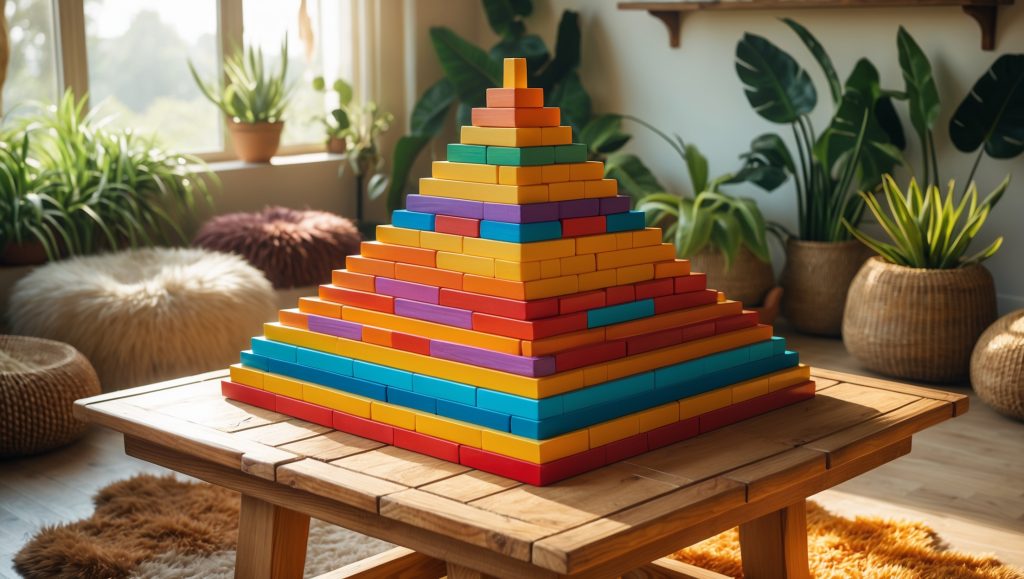
Overview
The Grimm’s Large Stepped Pyramid is a striking collection of 100 vibrantly colored wooden blocks, designed to spark imagination and support open-ended play for children ages 3 and up. This set stands out for its sheer size and versatility, offering children endless opportunities to build, design, and explore. Whether used for stacking, sorting, pattern creation, or collaborative building, the pyramid is especially appealing to families who value Montessori- and Waldorf-inspired learning. Its core play value lies in fostering spatial reasoning, creativity, and hands-on experimentation.
What’s Inside / Build Quality
The set includes 100 solid alder wood blocks, arranged in a 10-layered stepped pyramid. Each block is stained with non-toxic, water-based colors, ensuring safety for young users. The wood is sanded smooth, but intentionally left with a natural, tactile surface that aids grip and sensory exploration. The blocks vary in size from tiny 1-inch cubes to larger 8-inch pieces, all precisely cut for stable stacking and balanced play. The included wooden tray keeps the set organized, which is especially helpful for storage and cleanup.
Durability: Grimm’s toys are renowned for their long-lasting quality. The blocks withstand frequent drops and creative play without chipping or splintering.
Ease of Cleaning: Simply wipe with a damp cloth as needed—no harsh chemicals required.
Safety Notes: All finishes are non-toxic and compliant with US safety standards. While the blocks are generously sized, supervision is recommended for children under 3 due to potential choking hazards with the smallest pieces. Always check for wear and tear and store safely after play.
Learning & Development Benefits
The Grimm’s Large Stepped Pyramid excels at supporting a broad range of developmental skills:
- Fine Motor Skills: Children practice grasping, stacking, and balancing blocks, refining their dexterity and hand-eye coordination.
- Spatial Reasoning: Building towers, bridges, and complex structures helps children understand concepts like balance, symmetry, and geometry.
- STEM Thinking: Open-ended construction fosters an early love for engineering and problem-solving. Children experiment with weight, height, and stability.
- Sensory Exploration: The natural wood texture and vibrant colors invite tactile and visual exploration.
- Language & Social Skills: Collaborative play invites children to describe their creations, negotiate roles, and share ideas.
Play Prompts:
- Challenge your child to build the tallest tower they can and count how many blocks they used.
- Sort blocks by color or size, or create repeating patterns together.
- Pretend the blocks are buildings in a city, or create homes for toy animals.
- Encourage storytelling by arranging blocks into scenes or landscapes and making up stories about them.
Setup & Use
No assembly is required—simply open the box, and the set is ready to use. The sturdy wooden tray makes it easy to store the blocks neatly after play. While the blocks are large enough for most children to handle independently, adult supervision is recommended for younger or mixed-age groups, especially to ensure safe play with smaller blocks. Encourage children to return the blocks to the tray when finished, building habits of responsibility and care for their toys.
The set works well on rugs or hard floors. For larger creations, a flat, stable surface is ideal. Families with limited space should consider the set’s dimensions (about 14 x 14 inches when stored in the tray).
Pros & Cons
Pros
- High-quality, sustainably sourced materials
- Supports a wide range of developmental skills
- Endlessly open-ended—grows with your child
- Beautiful, non-toxic finishes safe for children
- Sturdy storage tray for organization
- Excellent for collaborative and solo play
Cons
- Higher price point than many block sets
- Large size may require significant storage space
- Some blocks are small enough to pose a choking risk for children under 3
- Natural wood may show wear over years of heavy use
- No instruction guide—may overwhelm children who prefer guided play
Alternatives & Similar Toys
- Lovevery Block Set: Modular wooden blocks with wheels, arches, and magnetic components. Slightly smaller set with more guided activity suggestions.
- Tegu Magnetic Wooden Blocks: Smooth, magnetic blocks for ages 1+ that click together. Great for travel and early STEM concepts.
- Bauspiel Color Street Blocks: Vibrant wooden blocks with embedded translucent gems—excellent for color mixing and light play.
- HABA Basic Building Blocks: Classic natural wood blocks in geometric shapes, ideal for open-ended construction and beginner builders.
- Melissa & Doug Wooden Building Blocks Set: Budget-friendly, colorful wooden blocks in various shapes, suitable for ages 3+ and group play.
Verdict
The Grimm’s Large Stepped Pyramid is a top-tier open-ended toy for families who value creativity, quality, and long-term play value. Its appeal spans a wide age range, making it a worthy investment for homes, classrooms, or therapy settings. The set is ideal for children who love to build, explore patterns, and challenge themselves with both simple and elaborate creations. While the initial cost and storage footprint are considerations, the developmental and play benefits are substantial.
This is not medical advice. For questions about toy safety, choking hazards, or developmental appropriateness, consult your pediatrician or a child development specialist.
If my child is a bit younger than 3 but closely supervised by grandparents who speak little English, are there any extra precautions or modifications we should consider when using this set together, especially with language barriers around safety instructions?
It’s so thoughtful that you’re considering both safety and communication while your child plays with their grandparents. Since some pieces in the Grimm’s Large Stepped Pyramid are small, make sure only larger blocks are used, especially with children under 3. Supervise play closely, and put away any pieces that fit inside a toilet paper tube to prevent choking risks. You might want to demonstrate safe play visually rather than relying on spoken instructions, and keep written or pictorial safety reminders nearby. Always supervise closely with young children. This isn’t medical advice; if you’re concerned, check in with your pediatrician.
With 100 blocks included, storage could get overwhelming. Is the wooden tray sturdy and practical enough on its own for daily family use, or have you found that additional storage solutions, like baskets or shelves, help keep things organized in a busy home?
You’re right to think ahead about keeping so many blocks tidy, especially in a busy family space. The wooden tray included with the Grimm’s Large Stepped Pyramid is sturdy for holding all 100 blocks and works well for setting up and putting away after each use, but it can be bulky for daily play and storage. Many families find it helpful to supplement with baskets or low shelves so children can access blocks easily and help clean up, which supports independence and safety. Choose storage options without sharp edges and keep smaller blocks out of reach of children under three. This isn’t medical advice; if you have specific concerns, check in with your pediatrician.
Does the set work well as a quiet activity for early mornings or right before bedtime, or do you find it’s better suited to active daytime play? I’m trying to fit creative play into a routine that keeps things calm in the evenings.
It makes sense to want calm activities for early mornings or bedtime. The Grimm’s Large Stepped Pyramid can be a quiet, soothing play option, especially if you guide your child to do gentle building or color sorting. For younger children (under 3), supervise closely due to the size and weight of the blocks. Try dim lighting, soft voices, and slow movements to keep the mood calm. Avoid rowdy play or tower-smashing close to bedtime, since this could be overstimulating. This isn’t medical advice; if you’re concerned, check in with your pediatrician.
For families on a tight toy budget, would you recommend investing in a high-quality set like this pyramid, or does using a monthly toy subscription offer a comparable range of developmental benefits over time?
It’s completely understandable to want the best developmental value for your budget. If you invest in a high-quality set like the Grimm’s pyramid, you get a durable, open-ended toy that supports creativity, problem-solving, and fine motor skills for many ages—just be sure to supervise younger children if small pieces are included. Monthly toy subscriptions can offer variety and introduce new skills, but may not allow for deep, lasting play with one material. Consider your child’s interests and play style, and rotate toys to keep things engaging. This isn’t medical advice; if you’re concerned, check in with your pediatrician.
If my toddler just turned two and is naturally drawn to stacking and sorting, would you recommend introducing the Grimm’s Large Stepped Pyramid under close supervision, or is it best to wait until they’re a bit older due to the small pieces?
It’s wonderful that your toddler is interested in stacking and sorting at this age. While the Grimm’s Large Stepped Pyramid is visually engaging and great for open-ended play, some of its smaller blocks could pose a choking risk for children under three. If you decide to introduce it now, always supervise play very closely and remove any pieces that are small enough to fit through a toilet paper roll (a common safety check). Alternatively, you could offer larger blocks for now and save the full set for when your child is a bit older. This isn’t medical advice; if you’re concerned, check in with your pediatrician.
Our child has some sensitivity to textures and sometimes avoids rough or natural wooden surfaces. Have you seen children with sensory processing challenges respond positively to the tactile finish of Grimm’s blocks, or should we look for something smoother?
It’s understandable to want your child to feel comfortable and engaged with their toys. Many children with sensory sensitivities do find natural wooden textures challenging, and Grimm’s blocks, while sanded smooth, still have a matte, slightly grippy feel. You might start by offering one block for brief, supervised play, watching for signs of discomfort. If your child resists, consider sanding a block further or seeking similar blocks with a lacquered or more polished finish. Always supervise younger children due to small parts, and check for splinters. This isn’t medical advice; if you have concerns, consult your pediatrician or occupational therapist for tailored guidance.
I see there are many sizes of blocks, including some as small as 1 inch. My child sometimes mouths toys absent-mindedly. How do you manage the smallest blocks in day-to-day play for kids who need extra supervision with small parts?
You’re right to be thoughtful about safety when little ones still mouth toys. For children who mouth objects, set aside the smallest blocks (under 1.25 inches) during unsupervised play. Offer only the larger blocks, and supervise closely when using the full set. You could introduce small blocks together for brief, shared activities, then put them away promptly. Store the tiny pieces in a separate, out-of-reach container until your child is developmentally ready. Always check blocks for wear or damage that could pose a hazard. This isn’t medical advice; if you’re concerned, check in with your pediatrician.
I noticed the smallest blocks are about an inch. Is there a certain age when you felt comfortable letting your child play with these unsupervised, or do you always reserve the set for family playtime?
It’s great that you’re thinking carefully about safety with smaller blocks. Generally, blocks that are about an inch can be a choking hazard for children under three, so I recommend reserving unsupervised play with the Grimm’s Large Stepped Pyramid for ages three and up. For younger children, always supervise closely and consider using the set only during family playtime. As your child matures and no longer mouths objects, you can gradually allow more independent play, checking in periodically. Every child is different, so trust your instincts and watch for safe play habits. This isn’t medical advice; if you’re concerned, check in with your pediatrician.
I noticed that the Grimm’s Large Stepped Pyramid is recommended for ages three and up. If my child is just under three but shows a lot of interest in building toys, can you suggest any specific ways to introduce this set safely to a younger toddler?
It’s wonderful that your toddler is showing an early interest in building toys. To introduce the Grimm’s Large Stepped Pyramid safely before age three, always supervise play closely to prevent mouthing or swallowing small pieces. Start with larger, easier-to-handle blocks and keep sessions short to match your child’s attention span. Remove any smaller blocks that could be choking hazards, and check for splinters or rough edges. Encourage stacking and knocking down towers together rather than complex structures at this age. This isn’t medical advice; if you’re concerned, check in with your pediatrician.
I’m comparing the Grimm’s Large Stepped Pyramid to other open-ended building sets for my language-delayed toddler. What makes this set particularly supportive for language and social development, beyond the fine motor and spatial benefits?
It’s wonderful that you’re looking for toys to support your toddler’s language and social growth. The Grimm’s Large Stepped Pyramid encourages joint play, which can prompt turn-taking and shared storytelling—great for building communication skills. Its colorful, varied blocks invite labeling, counting, and describing, giving lots of chances to model new words. You can narrate play, ask simple questions, or create pretend scenarios together, all of which boost expressive and receptive language. Always supervise closely, especially with younger toddlers, to ensure safe play. This isn’t medical advice; if you have concerns about your child’s speech or play, checking in with your pediatrician is best.