
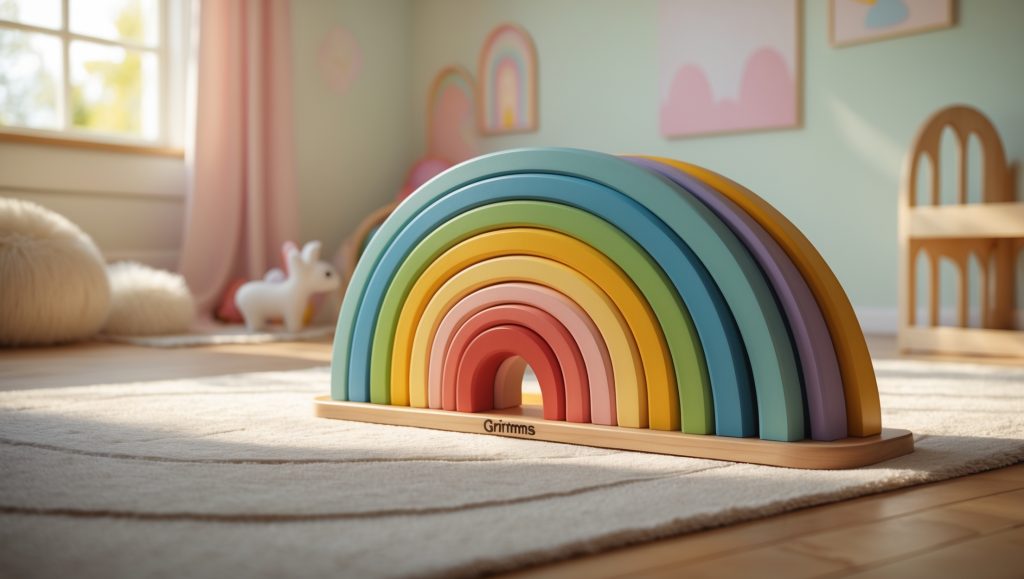
Overview
The Grimms Large Rainbow Stacker stands out as a beloved classic in the world of open-ended toys. Designed in Germany and handcrafted from sustainably sourced wood, it consists of twelve vividly colored arches that nest together to form a striking rainbow. But its appeal reaches far beyond the visual: this toy is renowned for its capacity to foster creativity, problem-solving, and independent play among children ranging from toddlers to school-aged kids.
Open-ended toys like the Grimms Rainbow Stacker are celebrated for their versatility. Children are not restricted by single-use features or fixed instructions—instead, they are encouraged to explore, build, and invent in limitless ways. In 2025, with growing interest in holistic, evidence-informed approaches to child development, the Grimms Large Rainbow remains a staple recommendation for families seeking toys that grow with their children.
What’s Inside / Build Quality
Upon unboxing the Grimms Large Rainbow Stacker, families are greeted with twelve arch-shaped pieces crafted from lime wood. Each arch is dyed using non-toxic, water-based stains, ensuring the natural wood grain shines through and providing a tactile, matte finish that is easy for little hands to grip.
- Size: The largest arch is approximately 15 inches wide and 7 inches high, making this set impressively substantial compared to many imitation stackers.
- Finish: The wood is smooth to the touch but intentionally left slightly textured for stacking stability. The colors are rich yet soft, with a signature gradient from red to purple.
- Safety: The toy is free from sharp edges and treated with child-safe, saliva-resistant dyes.
- Durability: Grimms toys are known for their resilience; the arches withstand years of enthusiastic play, occasional drops, and even teething toddlers.
The craftsmanship is immediately apparent, with high-quality joinery and finishes that highlight Grimms’ commitment to sustainable, ethical production. This is a toy that ages gracefully and can be passed down through siblings or generations.
Learning & Development Benefits
What sets the Grimms Large Rainbow apart is its extraordinary capacity to support children’s learning and development across multiple domains:
- Creativity & Imagination: Children instinctively use the arches as tunnels, bridges, dolls’ houses, fences, marble runs, and more. There is no single “right” way to play.
- Problem-Solving & Spatial Skills: Stacking, balancing, and combining arches in different configurations challenges children to experiment with cause and effect, balance, and design.
- Fine Motor Development: Handling the arches, especially when stacking or creating complex structures, refines dexterity and hand-eye coordination.
- Cognitive Growth: Open-ended play supports symbolic thinking, sequencing, and early math skills as children sort, order, and imagine new uses for the pieces.
- Language & Social Development: When used in group settings, the stacker inspires storytelling, collaborative builds, and negotiation, fostering social-emotional skills.
The rainbow can be integrated into themed play (e.g., color recognition, weather, or fairy tales) and adapted to different developmental stages, making it a highly inclusive choice for families with multiple children.
Setup & Use
Getting started with the Grimms Large Rainbow Stacker is refreshingly simple—no batteries, assembly, or noisy components required. Here’s what families can expect:
- Unboxing: The arches arrive nested, ready for immediate use. Remove any packing materials and wipe with a damp cloth if desired.
- Initial Play: Younger children often begin by nesting and un-nesting the arches or rolling them along the floor. Older children may quickly progress to more elaborate stacking and creative building.
- Care: The rainbow can be cleaned with a dry or slightly damp cloth. Avoid soaking or using harsh cleaners, as this may damage the wood or finish.
- Storage: The arches fit neatly together for compact storage, though many families display them on a shelf as both a toy and a decorative element.
There is no prescribed “right way” to play, and adult guidance is optional. Many parents delight in watching their child’s unique ideas unfold over time.
Pros & Cons
Pros
- Exceptionally versatile—supports a wide range of play styles and ages
- Beautiful, high-quality craftsmanship using sustainably sourced wood
- Non-toxic, child-safe dyes and finishes
- Promotes creativity, problem-solving, and open-ended exploration
- Durable and long-lasting—can be passed down through generations
- Attractive as both a toy and a playroom decoration
Cons
- Higher price point compared to plastic or mass-market alternatives
- Wood finish can show wear or dents over time with rough handling
- Large size may be challenging to store in very small spaces
- Some children may need encouragement or modeling to maximize open-ended potential
Alternatives & Similar Toys
If the Grimms Large Rainbow isn’t the perfect fit for your family, several other open-ended stacking toys offer similar benefits:
- Ocamora Rainbow Stacker: Handcrafted in Spain with a similar design, Ocamora’s rainbow features slightly different color palettes and wood grains for a unique look.
- Wooden Waldorf Stacking Arches: Many small businesses and independent makers offer their own takes on the classic stacking arch, often at a lower price point.
- Raduga Grez Mountains Stacker: Inspired by nature, this Russian-made set offers organic shapes and earthy colors, inviting new forms of imaginative play.
- Grimms Semi-Circles & Building Boards: Pairing the rainbow with Grimms’ complementary sets expands play possibilities, from ball runs to elaborate towers.
- Melissa & Doug Wooden Building Blocks: For families seeking traditional blocks, this set offers open-ended building at a more accessible price, though with less sculptural flair.
Each of these options emphasizes unstructured, imaginative play, but the Grimms Large Rainbow remains iconic for its scale, beauty, and adaptability.
Verdict
The Grimms Large Rainbow Stacker is a standout example of open-ended play at its finest. While it may require a greater initial investment than mass-market toys, its unparalleled versatility, quality, and developmental value make it a wise choice for families seeking toys that truly grow with their children. The stacker’s tactile appeal, safety, and timeless design ensure it will remain a cherished fixture in homes and classrooms long after the initial excitement of unboxing.
If you’re looking for a toy that encourages independent thinking, creativity, and countless hours of unplugged play, the Grimms Large Rainbow is a compelling investment. Its enduring popularity among educators, therapists, and families speaks to its effectiveness in nurturing whole-child development—one colorful arch at a time.
FAQ
+What age is the Grimms Large Rainbow Stacker best for?
+Is the wood finish safe if my child chews on the arches?
+How do I clean and care for the rainbow stacker?
+Can multiple children play with the rainbow at once?
+Does the toy come with instructions or play ideas?
+How does the Grimms Rainbow compare to plastic stackers?
+Is it worth the higher price?

Grimms Large Rainbow Stacker stands out as a quintessential open-ended wooden toy, beloved by parents, educators, and children alike. Its vibrant, non-toxic colors and smooth, tactile finish invite hours of imaginative play. Unlike many toys that dictate a single use, the Rainbow Stacker inspires creativity—children transform it into bridges, tunnels, mountains, or abstract sculptures. The durable alder wood construction ensures it can withstand years of enthusiastic play, making it a worthy investment for families seeking toys that grow with their children.
What truly sets Grimms Rainbow Stacker apart is its versatility. It supports early STEM concepts like balance, symmetry, and spatial reasoning, while also nurturing fine motor skills. The open-ended nature fosters independent thinking and social play, as children collaborate to build and invent new worlds. Parents will appreciate the minimalist design that looks beautiful on any shelf, echoing a Montessori philosophy of less is more.
While the initial cost may seem high, the enduring quality and play value justify the investment. In a world of fleeting plastic toys, Grimms Large Rainbow Stacker remains a timeless classic—one that will be cherished for generations.
- Encourages open-ended, imaginative play
- Made from sustainable, non-toxic materials
- Supports STEM learning and motor skills
- Beautiful, timeless design complements any home
You mentioned the arches have a tactile, matte finish. Is this texture stimulating enough for a sensory-seeking toddler, or would you suggest adding other materials or toys for varied sensory input during play sessions?
Your attention to your toddler’s sensory needs is wonderful. Grimms Large Rainbow’s matte, slightly rough texture does provide some tactile input, but for a sensory-seeking child, you might want to add more variety. Try offering other safe materials, like silicone stacking cups, textured balls, or fabric squares in different weaves and thicknesses. Always supervise closely, especially with small items or pieces. Mixing in these options helps meet sensory needs while keeping play safe and age-appropriate. This isn’t medical advice; if you’re concerned, check in with your pediatrician.
How does this stacker compare to other open-ended wooden toys like building blocks or shape sorters when it comes to keeping a 1-year-old engaged during longer daycare days? I want to pick something that really holds their attention.
It’s great that you’re looking for toys to keep your 1-year-old engaged, especially during long daycare hours. The Grimms Large Rainbow Stacker stands out because its colorful arches can nest, stack, and be used as tunnels or bridges, supporting creativity and longer periods of play. With simple building blocks, little ones may lose interest more quickly, while shape sorters focus on matching skills and can sometimes frustrate toddlers at this age. For a 1-year-old, supervise closely due to the size and weight of wooden pieces, and use only age-appropriate toys without small parts. This isn’t medical advice; if you’re concerned, check in with your pediatrician.
If we want to introduce the Grimms Rainbow to our two-year-old who often prefers quick, guided activities, do you have suggestions for starting out so it doesn’t just become another unused item on the shelf?
It’s understandable to want toys to be engaging, especially for a toddler who prefers quick, structured play. To start, try building simple towers or arches together, describing each step as you go. Offer prompts like matching colors or making a ‘bridge’ for their favorite toy car. Keep sessions short—about 10 minutes—so it feels manageable and fun. Supervise play to ensure safety, as the pieces are large but may still be tossed or dropped. Over time, let your child take the lead with stacking or sorting when they show interest. This isn’t medical advice; if you’re concerned, check in with your pediatrician.
How do the open-ended play and developmental benefits of the Grimms Large Rainbow compare to those offered by high-quality plastic stackers? Are there specific skills or play patterns that wooden toys seem to support better?
Your question about how wooden and plastic stackers differ shows a thoughtful approach to your child’s development. Both types help with fine motor skills and spatial reasoning, but wooden toys like the Grimms Rainbow often inspire more open-ended, imaginative play—children may use the arches as tunnels, bridges, or art, beyond just stacking. The natural texture and weight of wood can also enhance sensory exploration and hand strength. Always supervise young children, as large wooden pieces are safest for ages 1 and up due to size and weight. This isn’t medical advice; if you’re concerned, check in with your pediatrician.
My child has some sensory sensitivities and sometimes avoids certain toys because of texture. Do you have any insight into how the slightly textured finish of the wood feels in hand, and whether it tends to appeal to children who are sensory-seeking versus sensory-avoidant?
It’s understandable to want to find toys that feel comfortable for your sensory-sensitive child. The Grimms Large Rainbow Stacker has a matte, slightly rough texture due to its natural, unvarnished wood and subtle finish. Some sensory-seeking children enjoy the tactile feedback, but sensory-avoidant kids might find it a bit scratchy. If your child is sensitive to textures, offer the stacker alongside smoother wooden toys and watch their reaction. Allow brief, gentle exploration first, and consider placing a thin cotton cloth over the pieces if needed. Always supervise, especially with younger children, to make sure they’re comfortable and safe. This isn’t medical advice; if you’re concerned, check in with your pediatrician.
I noticed the finish is slightly textured for stacking. Do you think this is beneficial or potentially tricky for kids who might have some sensory sensitivity, especially as they transition out of diapers and start new routines around the potty?
You’re right to consider sensory sensitivities, especially during routines like potty training when children may be more aware of new sensations. A textured finish can help with grip and stacking, but for children sensitive to textures, it could feel uncomfortable or distracting. Try introducing the rainbow stacker during calm playtime first, and observe your child’s reactions. Let them handle one piece at a time, and offer reassurance if they seem unsure. Always supervise play and avoid forcing interaction. If your child shows strong discomfort, you might want to pause and revisit later. This isn’t medical advice; if you’re concerned, check in with your pediatrician.
For families on a tighter budget, does investing in a single high-quality open-ended toy like the Grimms Rainbow really offer more play value over time compared to having several smaller, educational toys? Is there research to support this kind of choice?
It’s understandable to want the best value for your child’s play, especially when budgeting. Research suggests that open-ended toys like the Grimms Rainbow can support creativity, problem-solving, and social skills over time because children use them in many ways as they grow. Fewer, high-quality toys may actually encourage deeper, longer engagement than a collection of single-purpose toys. For toddlers and preschoolers, sturdy wooden toys are safe with supervision but always check for loose parts. Each family’s needs are different, and this isn’t medical advice—if you have concerns about your child’s development or play habits, it’s worth discussing with your pediatrician.
Since my child sometimes gets overwhelmed by vivid colors and new textures, how would you rate the sensory experience with the Grimms Large Rainbow? Are the colors and finishes gentle enough for kids who might be sensitive in that area?
Your concern about sensory overwhelm is very valid, especially for children sensitive to color and texture. The Grimms Large Rainbow uses non-toxic, water-based stains that result in bright but not flashy colors, and the wood surface is smooth with a matte finish—free from harsh gloss or roughness. To help your child adjust, try introducing just one or two arches at a time, letting them explore at their own pace. Always supervise play, especially with younger kids. If your child shows discomfort, it’s okay to pause and try again later. This isn’t medical advice; if you’re concerned, check in with your pediatrician.
I’m hesitating between investing in the Grimms Rainbow or a simpler, less expensive wooden toy for the bathroom during potty training. Is there a noticeable developmental advantage at this age, or would a smaller set work just as well?
It’s thoughtful to consider whether a larger investment supports your child’s development during potty training. For toddlers, both the Grimms Rainbow and a simpler wooden set can encourage creativity and fine motor skills, but in a bathroom setting, a smaller set might be more practical and safer—fewer pieces to manage and less risk if they get wet or slippery. Open-ended play can happen with either size, so choosing a set that’s easy to clean and supervise is key. Whichever you pick, always supervise for safety during bathroom play. This isn’t medical advice; if you’re concerned, check in with your pediatrician.
I love the idea of handing toys down to younger children, but with the Grimms Stacker’s arch sizes, is there ever a concern about any pieces coming loose or breaking into smaller chunks that might be dangerous for toddlers?
It’s wonderful that you’re thinking ahead about toy safety for younger siblings. The Grimms Large Rainbow Stacker is made from solid wood, with each arch crafted as a single piece, so breakage is rare with typical play. However, always inspect for cracks, splinters, or loose paint before handing it to a toddler. For children under three, supervise play closely and avoid small pieces from other sets that could mix in. If a piece ever shows damage, set it aside until repaired. This isn’t medical advice; if you have concerns about toy safety, please ask your pediatrician.
Are there specific cleaning recommendations for spills or sticky hands, since wooden toys can’t be submerged like plastic ones? I want to make sure we can keep it hygienic without damaging the finish or color over time.
That’s a thoughtful question—keeping toys clean is so important, especially with little ones’ sticky hands. For the Grimms Large Rainbow Stacker, wipe spills promptly with a slightly damp (not wet) cloth, then dry immediately with a soft towel. For stickier messes, use a mild soap diluted in water on a damp cloth, but avoid soaking or using harsh cleaners. Never submerge the pieces, as moisture can warp wood or fade colors. For children under three, check for any splinters after cleaning. This isn’t medical advice; if you’re concerned or the toy is heavily soiled, reach out to your pediatrician for guidance.
I noticed the Grimms Large Rainbow Stacker is sized quite generously compared to other rainbow toys. We have a small apartment with limited storage space. Do you have any practical tips for keeping it organized when not in use?
It’s completely understandable to want to keep your living space tidy, especially with a larger toy like the Grimms Large Rainbow Stacker. You might try stacking the arches back together and storing them vertically on a bookshelf to save floor space. Using a low, open bin or basket can make it easy for your child to access the pieces and help with cleanup. If possible, dedicate a single shelf or corner as a ‘toy zone’ to contain clutter. Just be sure the storage spot is sturdy and within safe reach for your child’s age. This isn’t medical advice; if you have storage or safety concerns, check in with your pediatrician.
Could you elaborate on how wooden toys such as Grimms Rainbow Stacker might impact kids with sensory sensitivities? My child sometimes prefers smoother textures or different materials. Are there specific aspects of wood vs. plastic toys that parents should consider in this regard?
It’s very thoughtful to consider your child’s sensory preferences when choosing toys. Wooden toys like the Grimms Rainbow Stacker offer a unique tactile experience—wood feels warmer and more textured than plastic, which some kids find grounding, while others may prefer the uniform smoothness of plastic. You can try offering your child both types in short, supervised sessions to see which textures are most comfortable. For children sensitive to roughness, check the wood is finely sanded and finished with non-toxic, hypoallergenic coatings. Always monitor for splinters, and avoid small parts for younger kids. This isn’t medical advice; if you’re concerned, check in with your pediatrician.
If my baby tends to throw toys sometimes, especially after meals when hands are messy, will the Grimms Large Rainbow Stacker hold up to occasional drops or a bit of banging on the high chair tray? I’m worried about both durability and keeping it safe for further use.
It’s completely understandable to want toys that can handle a bit of rough play and mess. The Grimms Large Rainbow Stacker is quite sturdy and can usually withstand gentle drops or knocking, but repeated hard banging or being thrown might dent the wood or chip the color over time. After messy meals, wipe the stacker with a damp cloth and dry it thoroughly to keep the finish in good condition—avoid soaking or harsh cleaners. For safety, supervise play at the high chair and remove any small pieces if your baby is under 3 years old. This isn’t medical advice; if you’re concerned, check in with your pediatrician.
You mention the stacker is free from sharp edges and uses saliva-resistant dyes. Are there any scents from the wood or finishes that linger after unboxing? My child notices strong natural or chemical smells and it can be a distraction.
It’s thoughtful to consider your child’s sensitivities to smells. Grimms stackers are made from untreated, sustainably sourced wood and finished with water-based, non-toxic stains, so any scent tends to be mild and natural, like fresh wood, rather than chemical. If you notice a lingering smell after unboxing, try airing out the stacker in a well-ventilated room for a day or two before play. Wiping it gently with a clean, damp cloth can also help. Always supervise younger children, especially if they’re mouthing toys. This isn’t medical advice; if you’re concerned, check in with your pediatrician.
Is there an ideal daily routine you’d recommend for a preschooler that balances screen time with open-ended toy play, like the Grimms Rainbow? Sometimes it feels hard to know when we’ve spent enough time unplugged versus allowing a short video or game.
It’s completely normal to wonder about the right balance between screen time and hands-on play for your preschooler. Try starting with clear routines: 1) Set aside 30–60 minutes after breakfast or nap for unplugged play with toys like the Grimms Rainbow, encouraging creativity and fine motor skills. 2) Limit screens to a specific short window, such as 20–30 minutes after lunch, using high-quality content. 3) Involve your child in cleanup and transitions, giving advance notice before screens end. 4) Make sure play areas are safe and age-appropriate, especially if siblings are present. This isn’t medical advice; if you’re concerned, check in with your pediatrician.
How would you recommend balancing a single purchase like the Grimms Rainbow Stacker versus a subscription box that brings new playthings each month? For families on a tight budget, is it truly more cost-effective to invest in one classic, or will kids outgrow it too fast?
It’s great that you’re thinking carefully about both budget and your child’s play needs. A classic toy like the Grimms Rainbow Stacker is designed to grow with your child, offering open-ended play from toddlerhood through early school years, so it’s unlikely to be outgrown quickly. Consider starting with the stacker, exploring its many uses—stacking, building, pretend play—together. Rotate other household items for variety rather than buying more toys. If you ever want extra novelty, try simple DIY activities with your child. Always supervise little ones under three due to small parts or rough play. This isn’t medical advice; if you’re concerned, check in with your pediatrician.
When I compare the Grimms Rainbow Stacker to more budget-friendly or mass-market alternatives, is the investment mainly about durability or are there unique developmental benefits you have noticed, especially when the toy is shared among siblings and grandparents from different generations?
It’s thoughtful that you’re weighing both cost and value for your family. While durability is a factor—the Grimms Rainbow Stacker uses solid wood and non-toxic stains—there are also unique developmental benefits. Its open-ended design encourages creativity, problem-solving, and social skills as kids and adults of all ages join in play. Sharing among siblings and grandparents can foster communication and collaborative building, while the simple shapes are safe for ages one and up with supervision. Remember, each family’s needs are unique—this isn’t medical advice, so consult your pediatrician if you have specific concerns.
My baby is just turning 7 months, and everything goes straight into her mouth right now. Are the Grimms Rainbow arches safe for this age, and do you have any tips on cleaning them if she chews on them a lot?
It’s completely normal for your 7-month-old to put toys in her mouth—exploring by mouthing is how babies learn. The Grimms Large Rainbow arches are made from natural wood and non-toxic water-based stains, so they’re generally safe for mouthing, but always inspect for loose splinters or damage before play. For cleaning, simply wipe the arches with a damp cloth and let them air dry—avoid soaking or harsh cleaners, as water or chemicals can damage the wood. Supervise closely to ensure no small pieces break off. This isn’t medical advice; if you’re concerned, check in with your pediatrician.
My toddler has some sensory sensitivities and can be picky about textures. You mention the wood is left slightly textured for grip—have you seen children react negatively to this, or is it usually comfortable for little hands?
It’s thoughtful of you to consider your toddler’s sensory preferences. In my experience, most children find Grimms Rainbow’s finish comfortable—it’s smooth but not glossy, providing gentle grip without being rough. However, some sensitive toddlers may notice the slight texture. To help, you could let your child touch the toy with supervision before play, introduce it gradually, and watch for any discomfort. If your child is very sensitive, gently sanding a piece with fine sandpaper (avoiding splinters) can sometimes help. Always supervise play to ensure safety. This isn’t medical advice; if you’re concerned, check in with your pediatrician.
My child is almost two and still explores toys with their mouth at times. Are there any size guidelines or tests I can use at home to make sure smaller arches from this set don’t accidentally fit into the choking hazard category?
It’s completely understandable to want to keep your toddler safe as they explore toys with their mouth. For children under three, each piece should be larger than 1.25 inches in diameter and at least 2.25 inches long. You can use an empty toilet paper roll as a quick test at home—if a piece fits entirely inside, it’s too small. Always supervise play, especially if any arches are smaller. Check periodically for wear or splintering, as this can pose new risks. This isn’t medical advice; if you’re concerned, check in with your pediatrician.
My two-year-old sometimes gets overwhelmed by very bright colors or too many components at once. In your experience, do the rich colors and size of the Grimms stacker ever cause sensory overload for young children?
You’re thoughtful to notice how your child responds to colors and complexity. Some two-year-olds can feel overstimulated by bold colors or lots of pieces. Try starting with just a few arches at a time, and introduce more only when your child seems relaxed. Arrange the stacker in a simple shape, reducing visual clutter. Play in a softly lit area to help tone down intensity. Always supervise play to ensure safety with larger pieces. This isn’t medical advice; if you’re concerned, check in with your pediatrician.
I saw that the arches are purposefully textured for better stacking. Do you find wooden toys like these work well for children who are sensitive to touch, or could the texture be uncomfortable compared to the smoother feel of some plastic toys?
It’s thoughtful to consider how texture might affect children who are sensitive to touch. For some, the subtle grain and texture of unfinished wood can be grounding and pleasant, while others might find it distracting or uncomfortable compared to smoother plastic. If your child is sensitive, let them explore the arches under supervision and watch their reaction. You can also introduce the toy gradually, perhaps starting with socks or a cloth barrier so they can adjust at their own pace. Always check for splinters, and for very young children, supervise play to prevent mouthing. This isn’t medical advice; if you’re concerned, check in with your pediatrician.
My child is sensitive to textures and occasionally avoids wooden toys that feel rough. Since the finish is described as slightly textured for grip, do children with sensory sensitivities usually adapt to it, or might it be a challenge for them?
It’s very thoughtful of you to consider your child’s sensory sensitivities with new toys. Some children with tactile sensitivities may find the Grimms Rainbow’s textured, grippy finish uncomfortable at first, while others gradually adapt with time and gentle exposure. You could start by letting your child explore the stacker with supervision, perhaps by touching it with a cloth or playing alongside you. If they show discomfort, pause and try again later, or use a soft cloth to smooth the surface temporarily. Always watch for signs of distress and follow your child’s lead. This isn’t medical advice; if you’re concerned, check in with your pediatrician.
Since the arches are finished with a matte texture for stacking, have you noticed any issues with dust or dirt sticking to them over time? What’s the best way to clean or maintain the wood and colors without damaging the finish or the non-toxic dyes?
You’re right to wonder about keeping the Grimms Rainbow clean, especially since little hands are always exploring. Dust and dirt can cling to the matte finish, but gentle care usually keeps it looking great. First, regularly wipe arches with a dry or slightly damp cloth—never soak or use harsh cleaners, as these may damage the wood or fade the non-toxic dyes. For stubborn spots, try a soft brush. Make sure pieces dry completely before stacking to prevent warping. These techniques are safe for all ages, but supervise young children to avoid mouthing wet pieces. This isn’t medical advice; if you’re concerned, check in with your pediatrician.
You mention the size and sturdiness of the largest arch. Are there any specific safety guidelines you recommend for supervising very young children during play, particularly if they tend to climb or throw toys during independent time?
You’re right to think about safety, especially with energetic toddlers. For children under three, always supervise closely—never leave them alone with large, solid arches that could be heavy if dropped or thrown. Place the stacker on a soft play mat to cushion any falls, and set clear boundaries that climbing is not allowed. If your child tends to throw, offer alternatives like soft balls and use the rainbow only with direct adult guidance. Check regularly for any splinters or damage. This isn’t medical advice; if you’re concerned, check in with your pediatrician.
Is the texture of the wood suitable for kids who get bothered by certain sensations or who don’t like rough surfaces? My little one is sometimes picky about how things feel in their hands, so I’m curious if the arches are smooth enough.
It’s so thoughtful that you’re considering your child’s sensory preferences. The Grimms Large Rainbow Stacker usually features a gently sanded, natural finish—smooth but not glossy. For sensitive kids, here are some steps: 1) Let your child gently touch a single arch first, supervised, to gauge their comfort. 2) Feel the toy yourself—if any area seems rough, lightly sand it with very fine sandpaper. 3) Always check for splinters or rough edges before play, especially for toddlers. 4) If your child dislikes the texture, consider wrapping an arch in a soft cloth during initial play. This isn’t medical advice; if you’re concerned, check in with your pediatrician.
Do you have advice for parents of sensory-seeking kids who might be sensitive to certain textures or finishes? Is the slightly textured surface of the Grimms Rainbow arches comfortable enough for children who can be picky about how toys feel?
It’s thoughtful to consider your child’s sensory preferences when choosing toys. The Grimms Large Rainbow Stacker is known for its slightly rough, natural wood texture due to the non-toxic, water-based finish. For sensory-seeking kids, this can be appealing, but for children who are sensitive to textures, it may feel a bit scratchy. I suggest letting your child touch a similar wood surface before buying, or starting with supervised play to see their reaction. For toddlers, always supervise to prevent chewing on the arches. If your child dislikes the feel, you might add a soft cloth or scarf over the arches for play. This isn’t medical advice; if you’re concerned, check in with your pediatrician.
Does this toy suit kids who get easily overwhelmed by bright colors or large toys? Sometimes my little one gets overstimulated and I’m curious if the size or design might be too much at her age.
You’re thoughtful to consider how the Grimms Large Rainbow Stacker might affect a child sensitive to sensory input. The stacker’s bright colors and substantial size can be engaging, but for some young children, this might feel overwhelming. You could introduce just a few arches at a time, allowing your child to explore at their own pace. Try presenting the pieces in a quiet, uncluttered area, and observe how your child responds. For toddlers, always supervise play to ensure safety, especially if they’re still mouthing objects. This isn’t medical advice; if you’re concerned, check in with your pediatrician.
If my child is easily overwhelmed by bright colors or textured surfaces, would you say the Grimms Large Rainbow is still a good fit? Are there any gentle ways to introduce it for kids with sensory sensitivities?
It’s thoughtful to consider your child’s sensory needs before introducing a new toy. The Grimms Large Rainbow is smooth and made from natural wood, but its vibrant colors can be visually intense for some children. You might start by offering just one or two arches in softer colors, letting your child explore at their own pace. Introduce it in a quiet, familiar space, and watch for your child’s cues—remove it if they seem overwhelmed. Always supervise play, especially if your child is very young. This isn’t medical advice; if you’re concerned, check in with your pediatrician.
With apartment living, space is always at a premium. How easy is it to store the Grimms Large Rainbow Stacker in a smaller home? Do the arches nest compactly, or do they take up a lot of shelf space when not in use?
It’s completely understandable to want toys that fit well in a smaller space. The Grimms Large Rainbow Stacker does nest together, so the arches can be stored as a single stack, making it more compact than you might expect. Try keeping it stacked on a shelf, in a low bin, or even as a decorative piece when not in play. If you have very limited shelf space, consider storing it vertically or in a corner to minimize its footprint. Just keep the arches together to avoid losing pieces, and supervise young children, as the larger arches can be a bit unwieldy for little ones. This isn’t medical advice; if you’re concerned, check in with your pediatrician.
With a toddler who loves building but also a baby who puts everything in her mouth, how easy is it to keep track of all twelve arches and make sure none go missing? Any tips for keeping the set together in a busy household?
It’s completely understandable to want to keep all the pieces together, especially with little ones at different stages. Set up a specific play area for the Grimms Rainbow, ideally out of baby’s reach, and use a dedicated basket or bin for storage when not in use. After playtime, count and stack the arches together as a quick routine—toddlers often enjoy helping! Supervise closely when both kids are around, and check under furniture or favorite hiding spots regularly. Although the arches are large and not a choking risk, always keep an eye on baby during play. This isn’t medical advice; if you’re concerned, check in with your pediatrician.
If I wanted to introduce stacking and nesting concepts in short sessions, what kind of play routine would you recommend for a baby my child’s age using the Grimms Rainbow?
It’s great that you want to gently introduce stacking and nesting concepts. For infants around 12 months, start by showing how to take apart and reassemble two or three rainbow arches at a time. Sit together on the floor, letting your child explore the pieces with their hands and mouth (supervise closely to avoid mouthing hazards). You can model simple stacking, then pause so they can try. Name colors and shapes as you go. Keep sessions short—just 5 to 10 minutes is enough for little ones. Remember, every child develops at their own pace. This isn’t medical advice; if you’re concerned, check in with your pediatrician.
My child sometimes gets overwhelmed by very bright colors or a lot of pieces at once. How might the Grimms Rainbow work for children with mild sensory sensitivities, and are there ways to introduce it gently into their play?
It’s thoughtful to consider your child’s sensory sensitivities when introducing new toys. Start by offering just a couple of the larger, less brightly colored arches—avoiding the full stack at first. Let your child explore the texture and weight at their own pace, keeping other pieces out of sight. Play together in a calm, familiar space, and use the stacker for simple, slow activities like making tunnels or bridges. Always supervise play, as even large pieces can be surprising to sensitive children. This isn’t medical advice; if you’re concerned, check in with your pediatrician.
I’m curious if you’ve seen this stacker be soothing for children with strong sensory needs. Are the colors or textures ever overstimulating for kids who might be extra sensitive at the end of the day?
Your thoughtfulness about sensory needs is so important. Many children with sensory sensitivities do find the smooth wood and muted, non-glossy colors of the Grimms Rainbow Stacker calming, as it lacks harsh textures or overly bright hues. To help your child, try introducing one or two arches at a time, rather than the full set, and let them explore at their own pace in a quiet space. If the colors ever feel too much, you can start with the natural wood version. Always supervise play, especially for younger children, and watch for signs of overstimulation. This isn’t medical advice; if you’re concerned, check in with your pediatrician.
I have a two-year-old who still explores toys with her mouth. Since you mention the saliva-resistant dyes, have you noticed any wear or changes in the wood or color where kids tend to chew or suck on the arches over time?
It’s very normal for two-year-olds to use their mouths to explore toys. In my experience and based on feedback from families, the Grimms Large Rainbow Stacker’s saliva-resistant dyes hold up well to occasional mouthing, with only minor fading or roughness after repeated chewing. To keep things safe, inspect the arches often for splinters or loose pieces, and gently wipe them down after play. Supervise closely, especially since wood can wear over time. If you notice any changes like peeling color or rough spots, set that piece aside for now. This isn’t medical advice; if you’re concerned about safety, check in with your pediatrician.
For families on a tighter budget, does the stacker still offer enough developmental value to justify the higher price compared to more affordable alternatives? Or are there realistic ways to get similar benefits with other toys?
Your concern about balancing cost with developmental benefits is completely valid. The Grimms Rainbow does offer excellent open-ended play opportunities, but you can also encourage creativity and problem-solving with more affordable toys. Consider using simple wooden blocks, nesting cups, or even safe household items like cardboard tubes for stacking and building. Rotate toys to keep things fresh and engage your child with open-ended questions during play. Always check that alternative materials are age-appropriate, smooth, and free of small parts or sharp edges. This isn’t medical advice; if you’re unsure about safety or development, your pediatrician is a great resource.
We’re considering options and noticed a lot of rainbow stackers on the market now. Is there a noticeable developmental difference between the original Grimms set and some of the less expensive alternatives, especially for twins who might be playing rougher or using it in different ways?
It’s great that you’re weighing options to support your twins’ play and development. The original Grimms Rainbow is known for its sturdy build, non-toxic finishes, and smooth edges, which are especially important if little ones play rough or mouth the pieces. Some less expensive alternatives may chip, splinter, or have less vibrant colors, which can affect sensory and motor experiences. Whichever you choose, supervise closely to ensure safety, especially for toddlers, and check for small parts or rough edges. This isn’t medical advice; if you have concerns about safety or development, check in with your pediatrician.
In terms of daily routines, do you have suggestions for incorporating the Rainbow Stacker into short, focused play sessions that fit around busy family schedules? How much time is ideal for fine-motor skill development with this kind of toy?
It’s great that you want to make the most of short, meaningful play sessions despite a busy schedule. Try setting aside 10–15 minutes a day for focused play with the Rainbow Stacker—enough time for fine-motor skill practice without overwhelming your child. Invite your child to stack, nest, or line up the arches, and have them place small blocks or figures on top under supervision. Let your child lead, and offer encouragement as they try different ways to balance or fit the pieces together. For toddlers and preschoolers, this amount of daily practice is both age-appropriate and safe with adult supervision. This isn’t medical advice; if you’re concerned, check in with your pediatrician.
Since the set is quite large, do you have any suggestions for practical storage solutions that keep all the pieces together but make it quick to set up and put away when I have to transition to another activity later in the afternoon?
It’s thoughtful to plan ahead for smooth transitions and easy clean-up with a large toy like the Grimms Rainbow Stacker. Consider using a shallow, wide basket or a low shelf where all the pieces can be stacked in their original arrangement. You might also try a fabric bin with handles for easy transport. Encourage your child to help with stacking as a part of the daily routine—this supports independence and keeps small parts from getting lost. For younger children, make sure the storage solution is sturdy and doesn’t pose a tipping risk. This isn’t medical advice; if you’re concerned, check in with your pediatrician.
We have limited storage space in our apartment. How easy is it to keep the Grimms Rainbow organized between uses, especially if siblings want to use it at separate times?
It’s very understandable to want toys that won’t take over your living space. The Grimms Large Rainbow comes apart into several arches, but they nest neatly together for compact storage—try placing them back in the original stack after play. You can also use a low, open bin or shelf so each child can easily access and return the pieces when they finish, encouraging sharing and tidiness. If siblings play separately, setting a simple rule about putting all arches away before the next turn can help. The wood is sturdy, but check for loose pieces with younger children to keep things safe. This isn’t medical advice; if you’re concerned, check in with your pediatrician.
If my child gets overwhelmed by too many colors or textures, would you recommend including the full Grimms Rainbow in a rotation cycle or splitting up the arches? Have you seen any benefits to introducing a limited number of pieces at a time for sensory-sensitive kids?
It’s completely understandable to want to support your child if they’re sensitive to colors or textures. For sensory-sensitive children, starting with just a few arches at a time can help reduce overwhelm and make play more manageable. You could introduce two or three arches in calming colors, then slowly add more as your child becomes comfortable. Offer opportunities for your child to explore with their hands under your supervision, watching for any signs of discomfort. Always check that pieces are clean and in good repair to avoid splinters or other hazards. This isn’t medical advice; if you’re concerned, check in with your pediatrician.
We are a small apartment family and try to limit how many toys we buy. If I’m deciding between the Grimms Large Rainbow and a basic plastic stacker, would the open-ended play justify the extra cost for a baby under one, or is this better for older toddlers?
It’s great that you’re being thoughtful about both space and your baby’s development. For a baby under one, simple stacking toys—whether wooden or plastic—support grasping, mouthing, and basic coordination. The Grimms Large Rainbow shines as children grow, offering open-ended play for toddlers and beyond (like building, sorting, and imaginative setups), but its size and weight may be less suited for very young babies. If budget and storage are priorities, a basic stacker is age-appropriate for now. You can always introduce more complex toys as your child gets older. This isn’t medical advice; if you’re concerned, check in with your pediatrician.
My child tends to get easily overwhelmed by bright colors and certain textures. Since the Grimms Rainbow is vibrant and has a matte finish, have you found this design suitable for kids with some sensory sensitivities, or would it be better to look for alternatives?
You’re right to consider your child’s sensory preferences when choosing toys. The Grimms Large Rainbow Stacker is brightly colored and has a matte, slightly rough wooden finish, which some children with sensory sensitivities may find overstimulating. You could try introducing one arch at a time to see how your child responds, always supervising play. If the colors or textures seem overwhelming, consider looking for similar stackers in muted tones or smooth finishes, which may feel more comfortable. Sensory needs are unique, so observing your child’s reactions is key. This isn’t medical advice; if you’re concerned, check in with your pediatrician.
My child is sensitive to certain textures. You mentioned the arches have a slightly textured finish for grip. Could you describe what that feels like up close, and have you seen children with sensory sensitivities respond well to this toy?
It’s great that you’re thinking about how your child’s sensory preferences might affect their play. The Grimms Large Rainbow Stacker arches have a matte, slightly rough finish—think of unfinished wood with a gentle grip, not smooth or glossy. Some sensory-sensitive children enjoy the natural feel, while others may prefer smoother surfaces. I suggest letting your child touch an unpainted wooden block first to gauge their comfort, supervising play closely, and having a soft cloth handy to smooth the arches if needed. Always check for splinters. Every child responds differently, so gentle observation helps. This isn’t medical advice; if you’re concerned, check in with your pediatrician.
If my potty-training toddler still loves to mouth toys, should I be concerned about wear or color fading on the Grimms arches from extra moisture? Your review mentions saliva-resistant dyes but I’d love details on real-life durability with heavy chewers.
You’re right to double-check safety when your toddler is still mouthing toys. Grimms uses water-based, saliva-resistant dyes, so light mouthing shouldn’t cause immediate fading or harm, but heavy chewing over time might show more wear or minor color loss, especially at the edges. Wipe arches dry after play to minimize moisture damage. Inspect regularly for splintering or paint changes—if you notice these, take that piece out of rotation. Always supervise, as no toy is fully chew-proof. This isn’t medical advice; if you’re concerned, check in with your pediatrician.
My toddler is very sensitive to certain textures and colors, and we have had trouble with some toys in the past. Since the Grimms Rainbow has a slightly textured wooden finish and a range of colors, do you know if this toy generally works well for children with sensory sensitivities?
It’s completely understandable to want toys that are comfortable and inviting for your sensory-sensitive toddler. The Grimms Large Rainbow Stacker has a natural, slightly rough finish from its non-toxic stains, which some children find soothing, but others may prefer a smoother texture. I suggest letting your child touch a similar wooden object first to gauge their reaction, introducing the stacker gradually, and supervising initial play to watch for any discomfort. You might also remove or separate certain colors if particular shades seem overwhelming. If texture or color issues arise, playing with the stacker over a cloth or with gloves can help. This isn’t medical advice; if you’re concerned, check in with your pediatrician.
Have you found it engaging enough to keep a two-year-old interested over time, or does it end up gathering dust after the first novelty wears off? I’m torn because it looks beautiful, but it’s a big investment if it won’t be played with daily.
It’s completely understandable to want toys that will truly engage your toddler, especially for a larger purchase. Many two-year-olds return to the Grimms Rainbow again and again, exploring stacking, sorting, and even simple pretend play. To keep interest high, try rotating it with other toys, modeling new ways to stack or build, and incorporating it into stories or themes your child enjoys. Supervise to ensure safe play, as pieces are chunky but could be thrown. Every child is different, so daily use can vary, but open-ended toys like this often grow with children. This isn’t medical advice; if you have concerns about play or development, check in with your pediatrician.
My child is very sensitive to textures and sometimes avoids toys that feel unfinished. You mention the arches are slightly textured for stacking—have you found this to be an issue for kids with sensory sensitivities?
It’s completely understandable to be mindful of textures if your child is sensitive. The Grimms Large Rainbow Stacker does have a slightly rough, natural wood finish, which helps with stacking but can feel scratchy or unfinished to some kids. You might start by letting your child touch just one piece alongside a familiar, comfortable object. If they’re hesitant, consider gently sanding a section to smooth it out, or offering the toy during times when your child feels regulated. Always supervise to ensure safety, especially with younger children. This isn’t medical advice; if you’re concerned, check in with your pediatrician.
We’re considering investing in the Grimms Large Rainbow but would like to know how it compares to more budget-friendly wooden stackers in terms of developmental benefits and build quality. Is the price difference really justified?
It’s thoughtful to weigh both quality and developmental value before making this purchase. The Grimms Large Rainbow stands out for its smooth, hand-sanded finish, non-toxic dyes, and durability, which make it safe for toddlers and preschoolers. Its size and weight allow for more complex building, fostering creativity and problem-solving longer than many budget stackers. However, simpler wooden stackers can also support fine motor skills and color recognition. If your child is under 3, always supervise play due to size and stacking challenges. This isn’t medical advice; if you’re concerned, check in with your pediatrician.
When potty training, accidents sometimes happen near our toys. Is the water-based stain on the Grimms arches easy to clean in case of a spill, or would you recommend extra precautions to keep them sanitary in a bathroom setting?
It’s understandable to want to keep your child’s toys clean during potty training. The Grimms Large Rainbow Stacker uses a water-based stain, which can handle gentle wiping with a damp cloth, but isn’t fully sealed against moisture. If a spill happens, wipe the arches promptly with a damp (not wet) cloth, then dry them thoroughly with a towel to prevent warping or damage. For bathroom use, consider placing a washable mat under the toys or keeping them out of high-traffic potty areas. Always check for lingering moisture or residue, as wood can absorb liquids over time. This isn’t medical advice; if you’re concerned, check in with your pediatrician.
Since the Grimms Large Rainbow set is a bit of an investment, how well does it keep kids engaged over time compared to other open-ended toys? Is there a particular age when its appeal tends to fade, or do kids return to it even after starting school?
It’s understandable to want a toy that stays interesting as your child grows. The Grimms Large Rainbow tends to engage children from toddlerhood through early elementary years, thanks to its open-ended design. Younger kids (around 1–3 years) enjoy stacking and basic color sorting, while preschoolers and older children (up to 7 or 8) use it for imaginative play like building tunnels, bridges, or scenes. Some kids revisit it even after starting school, especially if they enjoy creative activities. Always supervise younger children, as pieces are large but could be climbed on. This isn’t medical advice; if you’re concerned, check in with your pediatrician.
My baby sometimes gets overwhelmed by too many bright colors and toys at once. Are the colors and size of the Grimms Rainbow Stacker visually stimulating without being overpowering for a 7-month-old with some sensory sensitivities?
It’s understandable to want to make playtime comfortable for your baby, especially with sensory sensitivities. The Grimms Large Rainbow Stacker uses vibrant but non-flashy, natural dyes, and the wooden texture is gentle on little eyes. For a 7-month-old, I suggest starting with just two or three arches to reduce visual input, introducing more as your baby seems ready. Always supervise play, watch for mouthing, and check for any reactions to wooden toys. Every baby is different—observe how yours responds and adjust accordingly. This isn’t medical advice; if you’re concerned, check in with your pediatrician.
With so many open-ended toys out there, I’m wondering how the Grimms Rainbow compares to other stackers or building sets for toddlers who are in that tricky potty training age. Is there something specific about the design that makes it stand out for young kids?
It’s great that you’re looking for toys that will support your toddler during the potty training stage. The Grimms Rainbow stands out because its large, smooth arches are safe for little hands and easy to grip, helping toddlers practice coordination and independence—important skills during potty training. Its open-ended design encourages creativity, whether your child is stacking, nesting, or making bridges. The pieces are free of small parts and finished with non-toxic stains, making them age-appropriate and safe for supervised play. Every child is different, so observe how your toddler engages, and always supervise play. This isn’t medical advice; if you’re concerned, check in with your pediatrician.
Could you elaborate on how toddlers of different ages might use the Stacker? For example, are there specific ways to introduce it to a younger toddler versus an older preschooler to best support their development?
—meeting your child where they are developmentally really helps them get the most from toys like the Grimms Large Rainbow Stacker. For younger toddlers (around 1–2 years), start by letting them explore the arches freely: stacking, knocking over, and feeling the different shapes and textures. Always supervise closely at this age due to the size of some pieces. For older toddlers and preschoolers (ages 3–5), encourage more complex play: building bridges, tunnels, or nesting the arches by size. You can also introduce simple color sorting or pretend play ideas as their imagination grows. Make sure play always stays age-appropriate and safe. This isn’t medical advice; if you have concerns, speak with your pediatrician.
Since this toy is treated with water-based dyes and described as saliva-resistant, is it safe if a teething toddler occasionally mouths the arches? How do you recommend cleaning them after such use?
You’re thoughtful to consider both safety and cleanliness for your teething toddler. Grimms stackers use water-based, non-toxic dyes and are designed to be saliva-resistant, which makes occasional mouthing generally safe under supervision for children aged 1 and up. For cleaning, gently wipe the arches with a damp cloth—avoid soaking, harsh cleaners, or submerging the wood to prevent damage. Always ensure the toy is fully dry before storing to avoid mold. This isn’t medical advice; if you notice any splintering or have concerns, check in with your pediatrician.
Our child has some mild sensory sensitivities, especially to certain textures or noises. Can you describe in more detail how the surfaces and finishes of each arch might feel to touch? Have you had feedback from families with sensory needs using this toy?
It’s thoughtful of you to consider how the Grimms Large Rainbow Stacker might feel for a sensory-sensitive child. Each wooden arch is smooth and lightly sanded, finished with non-toxic, water-based stains rather than glossy varnish, giving them a matte, velvety texture that most children find gentle to touch. There are no sharp edges or rough spots, and the wood is untreated, so it doesn’t feel slippery or sticky. Some families with sensory-sensitive children have shared that their kids enjoy the natural, quiet feel and muted sound when stacking, though a few notice the grain can feel slightly textured. Always supervise play to ensure comfort and safety. This isn’t medical advice; if you’re concerned, check in with your pediatrician.
With so many variations of wooden rainbow stackers available, what do you feel really sets the Grimms Large Rainbow apart in terms of developmental benefits or quality, especially if we’re trying to prioritize just a few quality toys?
It’s great that you’re prioritizing quality and developmental value in your toy choices. The Grimms Large Rainbow stands out for its size and sturdy construction, which invite both toddlers and older children to engage in creative, open-ended play—think tunnels, bridges, and balancing challenges. The non-toxic stains and smooth finish make it safer for young kids (even those who mouth toys). Its graduated arches encourage spatial reasoning, hand-eye coordination, and problem-solving without overwhelming little ones. If you’re picking just a few toys, Grimms’ versatility and long-lasting appeal mean it can adapt to many stages and play styles. This isn’t medical advice; if you’re concerned, check in with your pediatrician.
Would the size and weight of the largest arches make them difficult or unsafe for a 9-month-old to handle during independent play, especially if she is still working on her fine motor skills?
It’s thoughtful to consider your 9-month-old’s safety and abilities as she explores new toys. The largest Grimms Rainbow arches are quite big and can be a bit heavy for a baby her age, especially if she’s still developing her fine motor skills. For now, supervise her play closely, and offer her the smaller arches, which are lighter and easier to grasp. Place the larger arches on a soft surface to prevent bumps, and avoid stacking them too high. As she grows and her motor skills improve, she’ll be able to safely explore more pieces. This isn’t medical advice; if you’re concerned, check in with your pediatrician.
Does the size and weight of the largest arch make it tricky for younger toddlers to handle on their own? I’m wondering if it’s realistic to expect my just-turned-two-year-old to stack the whole rainbow independently.
It’s very thoughtful of you to consider your toddler’s abilities with the Grimms Large Rainbow. At just two years old, many children may find the largest arch a bit bulky or awkward to maneuver by themselves. You can help by showing your child how to lift and position the largest piece, stacking together at first. Allow them to explore the smaller arches independently, which are lighter and easier for little hands. Always supervise play to prevent pinched fingers or frustration. Remember, independent stacking of all pieces might come later as strength and coordination develop. This isn’t medical advice; if you’re concerned, check in with your pediatrician.
My child sometimes struggles with sensory processing, especially with certain textures. You mention the arches are intentionally left a bit textured for grip. Do you know if the feel of the wood is likely to bother sensitive kids, or have families found it generally comfortable for everyone?
It’s very understandable to want toys that feel comfortable for your sensory-sensitive child. The Grimms Large Rainbow Stacker has a textured, unvarnished wood surface, which many children enjoy for better grip, but some with tactile sensitivities might find it rough or ‘scratchy.’ If possible, let your child touch unfinished wood objects first to gauge their reaction. You could also rub the arches gently with a soft cloth to smooth them a bit (without sanding, which can change the toy’s look). Always supervise play, especially if your child is mouthing toys. This isn’t medical advice; if you’re concerned, check in with your pediatrician.
Do you have any suggestions for storing the full large stacker set, especially in smaller spaces? We have a tiny playroom and I want the toy to stay accessible but also organized to encourage my toddler to use it independently.
It’s great that you want to keep the Grimms Large Rainbow Stacker both organized and easy for your toddler to reach. Try using a low, open basket or shallow bin on a shelf at your child’s height—this keeps all the arcs together and visible. You could also stand the stacker upright in a cubby or on a tray, so your toddler can see the colors and shapes. Avoid stacking heavy items on top, and make sure the storage spot is stable and free from sharp edges. This isn’t medical advice; if you’re concerned, check in with your pediatrician.
I see the stacker uses non-toxic dyes, but does the color ever transfer or rub off onto hands or pajamas, especially if we’re playing in low light before bedtime? I want to make sure it is truly mess-free for late evening play.
It’s great that you’re thinking about keeping playtime clean and safe, especially before bedtime. The Grimms Large Rainbow Stacker is finished with water-based, non-toxic stains that are designed not to rub off during normal play, even in low light or with skin contact. To be extra sure, supervise play to prevent mouthing or rough handling, and occasionally check the blocks for any signs of wear. Always wash hands after play just in case. This isn’t medical advice; if you notice any unexpected residue or have concerns, consult your pediatrician.
My toddler still puts a lot of toys in their mouth—could you elaborate on how durable the dyes are with repeated chewing or drooling? I know you mentioned they are saliva-resistant, but does the color fade, or do parents need to take any special care with cleaning?
It’s completely understandable to be concerned about toy safety when your toddler is still mouthing objects. Grimms Large Rainbow Stackers use non-toxic, water-based stains that are designed to be saliva-resistant and safe for mouthing. The colors are unlikely to fade quickly from occasional chewing or drooling, but over time, some gentle wear could occur—this is normal for natural wood toys. Wash only with a damp cloth and avoid using harsh soaps or soaking, as this can damage the wood or finish. Always supervise play to ensure no small parts break off. This isn’t medical advice; if you’re concerned, check in with your pediatrician.
I’m curious how open-ended toys like the Grimms Rainbow stack up against more traditional educational toys with set instructions. In your opinion, is there an ideal mix of both types in a playroom, or can open-ended options meet most learning needs on their own?
It’s great that you’re thinking about how different toys support your child’s development. Open-ended toys like the Grimms Rainbow encourage creativity, problem-solving, and flexible thinking, while traditional educational toys with instructions can build focus and specific skills like counting or sequencing. For most preschool- and early elementary-aged children, a mix of both types works well—open-ended toys inspire imagination, and structured ones help practice following directions. Make sure all toys are age-appropriate and free from choking hazards. This isn’t medical advice; if you have concerns about your child’s play or learning, please consult your pediatrician.
We are considering the Grimms Rainbow but the cost is a bit steep. For families on a budget, do you find the developmental benefits are notably greater than with less expensive stacking toys, or is it possible to get similar play value from more affordable alternatives?
It’s very thoughtful to weigh the cost against the benefits when choosing toys for your child. While the Grimms Rainbow is beautifully made and supports open-ended, creative play, many less expensive stacking and nesting toys can also offer similar developmental benefits, such as spatial reasoning and fine motor skills. Look for toys made from safe, durable materials with smooth surfaces and non-toxic finishes. Encourage imaginative play by mixing household items or blocks with any stacker you choose. Always check for age-appropriateness and choking hazards for younger children. This isn’t medical advice; if you have concerns, consult your pediatrician.
My toddler sometimes gets frustrated stacking arches higher than three or four pieces—do you have suggestions for introducing basic stacking techniques to build confidence and fine-motor skills gradually? Should I start with just a few arches and add more over time?
It’s completely normal for toddlers to feel frustrated when learning new stacking skills. Start by offering just two or three arches at a time so your child can practice simple stacking without feeling overwhelmed. Show them how to gently balance one arch on top of another, using both hands for stability. Encourage your toddler to experiment with different sizes and orientations together, turning stacking into a playful exploration. Gradually add more arches as their coordination and confidence grow. Always supervise closely, and be mindful of any small pieces if younger siblings are nearby. This isn’t medical advice; if you’re concerned, check in with your pediatrician.
I noticed the arches are finished with water-based stains and are saliva-resistant, which is reassuring. Is there any specific cleaning routine recommended for when twins inevitably chew or drool on the pieces during teething phases?
You’re being thoughtful about your twins’ safety and hygiene during teething. For the Grimms Large Rainbow Stacker, gently wipe each arch with a slightly damp cloth and let them air dry completely; avoid soaking or using harsh cleaners, as this can damage the wood and finish. If there’s visible residue, use a mild, natural soap diluted with water, then wipe with a clean damp cloth. Always check for splinters or cracks before play. Supervise babies under three, especially if teething. This isn’t medical advice; if you’re concerned, check in with your pediatrician.
How does the Grimms Large Rainbow Stacker compare to similar, more budget-friendly rainbow stackers in terms of durability and developmental benefits? Is it really worth the higher investment for families, especially if we’re looking to get the most value over several years?
It’s natural to want the best value and longevity for your family’s toys. The Grimms Large Rainbow Stacker is crafted from solid, sustainably sourced wood with non-toxic stains, making it notably durable and safe for all ages—babies under supervision, and older children for years. Cheaper alternatives may use lighter wood, less stable dyes, or rougher finishes, which can splinter or fade. Developmentally, all rainbow stackers support creativity, fine motor skills, and problem-solving, but Grimms’ precise design allows smoother stacking and more complex play. If your goal is a toy that grows safely with your child and withstands heavy use, Grimms tends to offer lasting value. This isn’t medical advice; if you have concerns, talk with your pediatrician.
Would you recommend the Large Rainbow for a child closer to age 8, or is there a point where this toy might not feel as engaging? I’d love to invest in versatile pieces that truly grow with my child.
Your focus on versatile toys that continue to engage older children is wonderful. For an 8-year-old, the Grimms Large Rainbow can still be captivating, especially for imaginative building, creative play, and even simple STEM challenges like balancing or designing complex structures. Encourage open-ended projects—such as building marble runs or abstract sculptures—and invite your child to combine the pieces with other toys. At this age, children often appreciate the freedom to invent their own games. Just supervise if younger siblings are around, as some play ideas may involve stacking or balancing at heights. This isn’t medical advice; if you’re concerned, check in with your pediatrician.
You mentioned that kids often use the arches as tunnels and bridges. Do you have any tips for encouraging pretend play with everyday household items alongside the rainbow stacker to expand on these kinds of imaginative activities?
It’s wonderful that you want to nurture your child’s imagination with both toys and everyday items. To encourage pretend play, try providing safe household objects like wooden spoons, small boxes, or fabric scraps for your child to combine with the rainbow stacker—these can become cars, houses, or rivers in their stories. Join in the play by asking open-ended questions, such as ‘What could this arch be today?’ or ‘Who might travel through this tunnel?’ Rotate household items occasionally to keep things fresh and stimulating. Always ensure that items are age-appropriate—avoid small objects if your child is under three and supervise play to prevent choking hazards. This isn’t medical advice; if you’re concerned, check in with your pediatrician.
If my daycare already provides other wooden stackers or blocks, is there a noticeable difference in the way children engage with the Grimms Rainbow compared to more typical stacking toys? I’m trying to decide if it’s worth the investment as we prepare for this transition.
It’s thoughtful of you to consider how different toys might shape children’s play during a transition. The Grimms Large Rainbow often draws children into more imaginative, open-ended play—kids use the arches as tunnels, bridges, or balance elements, rather than just stacking. To explore its impact, you could observe if children show interest in making scenes or stories with curved shapes, or if they repeat similar patterns with standard stackers. For toddlers and preschoolers, the larger, smooth pieces can inspire creativity but always supervise to ensure safety. This isn’t medical advice; if you’re concerned, check in with your pediatrician.
My child is very sensitive to different textures. Is the slightly textured surface of the wood comfortable for sensory-sensitive kids, and have you seen any children react negatively to it during play?
It’s wonderful that you’re thinking about your child’s sensory needs. The Grimms Large Rainbow Stacker has a matte, slightly textured finish from natural oils and dyes, which most children find smooth and comfortable. For sensory-sensitive kids, I suggest: 1) Let your child touch one piece briefly before committing to play, 2) Observe their reaction closely for any signs of discomfort, 3) If tolerated, build up playtime slowly, and 4) Wash hands before play to minimize sensation from tiny wood fibers. Most children do well, but a few may dislike the texture. This isn’t medical advice; if you’re concerned, check in with your pediatrician.
If you had to choose between the Grimms Rainbow and some of the cheaper versions out there, is the difference mostly about durability or are there learning benefits my child would miss out on with an imitation set?
It’s thoughtful to consider both quality and learning benefits for your child. The Grimms Rainbow is well-known for its durability and non-toxic, child-safe finishes, which are especially important for babies and toddlers who mouth toys. While many imitation sets look similar, they may chip more easily or use paints that aren’t as rigorously tested for safety. Educationally, a well-made stacker with smooth, precise pieces allows for easier stacking and more creative play, supporting fine motor skills and imagination. If you choose a budget option, check materials, finishes, and size for age-appropriateness and safety. This isn’t medical advice; if you’re concerned, check in with your pediatrician.
With items like the Grimms Rainbow being fairly large, what are your recommendations for storing such toys in a small space when also receiving monthly subscription toys?
It’s understandable to feel overwhelmed managing big, beautiful toys like the Grimms Rainbow when space is tight and more toys keep arriving. First, consider stacking the rainbow pieces together after play—they nest neatly and take up less room. Use a low, open basket or storage bin to keep all the parts contained and easy to reach for your child. Rotate toys: store some subscription toys out of sight and swap them every few weeks to minimize clutter. For safety, make sure storage is stable and doesn’t block walkways or become a tripping hazard. This isn’t medical advice; if you’re concerned, check in with your pediatrician.
My 4-year-old sometimes gets frustrated with balancing stacker toys and quickly switches to wanting to watch TV instead. Are there gentle strategies to help build perseverance and keep her curious about problem-solving with the arches?
It’s understandable to want to encourage your child’s perseverance with toys like the Grimms Rainbow. Try creating small, achievable stacking challenges together, praising her effort rather than the end result. Demonstrate calm problem-solving when pieces fall, narrating your thought process to model resilience. Allow her to take breaks, returning to the toy later when she feels ready. For a 4-year-old, it’s also helpful to keep sessions short and positive, ensuring she’s not hungry or tired. Always supervise play due to the size and shape of the arches. This isn’t medical advice; if you’re concerned, check in with your pediatrician.
For families with both toddlers and older kids, should I supervise play differently to ensure the smaller pieces aren’t accessible to my youngest, or is the whole set generally safe for all ages who might share it?
It’s great that you’re thinking about safety for both your toddler and older children during play. For families with a wide age range, supervise play closely, especially if your toddler is under three, since some smaller rainbow arches could pose a choking risk. Consider letting your older child build with the full set while your toddler uses only the larger arches, and always clean up small pieces right after play. Store the smaller parts out of reach when not in use. This isn’t medical advice; if you’re concerned, check in with your pediatrician.
Is it possible to adapt play with the Grimms Rainbow Stacker as my toddler grows, or will they outgrow interest quickly? I’d love examples of how older preschoolers or early elementary kids might use it beyond basic stacking.
It’s great that you’re thinking about keeping your child engaged as they grow. The Grimms Rainbow Stacker can adapt for a wide range of ages—toddlers enjoy basic stacking and color sorting, while older preschoolers might use the arches as tunnels for cars, bridges for block towns, or props in imaginative storytelling. Early elementary kids often incorporate the pieces into marble runs, balance challenges, or creative art structures. Always supervise younger children for safety, especially around climbing and small accessory use. This isn’t medical advice; if you’re concerned, check in with your pediatrician.
I noticed the arches are quite large and seem sturdy, but I wonder about their weight. If my 10-month-old accidentally drops one on themselves or bangs it on a high chair tray while playing during mealtime, is there any risk of injury given their size and material?
It’s wise to consider safety when introducing new toys to your baby. Grimms Large Rainbow arches are made from solid wood, which means they are heavier than plastic toys and could cause a bump or startle if dropped on delicate fingers or toes, especially for a 10-month-old. During mealtime or high chair play, I recommend supervising closely, offering only one or two smaller arches at a time, and reserving the larger pieces for floor play. Always inspect the arches for any rough edges or splinters before use. This isn’t medical advice; if you’re concerned, check in with your pediatrician.
Since my toddler sometimes gets frustrated with toys that are tricky to balance, especially when learning new routines like potty training, do you find the texture and size of the arches helpful for early motor skills, or could the pieces be too challenging for a 2.5-year-old?
It’s so thoughtful that you want to support your toddler’s confidence during big transitions like potty training. The Grimms Large Rainbow Stacker arches are smooth and chunky, making them easier for little hands to grasp and stack, which can help refine motor skills. For a 2.5-year-old, start by letting your child explore the pieces freely, without any pressure to balance them perfectly. You can model simple stacking or use the arches in other ways, like tunnels or bridges, to keep things fun and frustration-free. Always supervise play, especially with larger pieces, and take breaks if your child seems overwhelmed. This isn’t medical advice; if you’re concerned, check in with your pediatrician.
Is the Grimms Large Rainbow easy to integrate into daily routines, such as quiet time or independent play, or does it work better when used in more supervised or guided activities?
It’s great that you’re thinking about how to fit the Grimms Large Rainbow into your child’s daily routine. This toy is very versatile and works well for both quiet, independent play and more guided, adult-supported activities. For quiet time, you can encourage your child to stack, nest, or create simple patterns, which is generally safe for ages 3 and up due to the large pieces. For younger toddlers, closer supervision is important because of potential mouthing or rough handling. During guided play, you can introduce themes like color sorting or imaginative building. This isn’t medical advice; if you have concerns about play safety or developmental readiness, check in with your pediatrician.
For a preschooler with emerging problem-solving skills, what types of challenges or construction ideas do you suggest to help them get the most developmental benefit out of the rainbow stacker during independent play?
It’s wonderful that you want to encourage your preschooler’s problem-solving skills with the rainbow stacker. Try inviting your child to build a tall tower by balancing the arches in creative ways, or challenge them to fit all the pieces back together in a specific order. Encourage making tunnels for cars or animals, and see if they can create bridges or enclosures using only the stacker. All of these activities nurture spatial reasoning and persistence. Preschoolers (ages 3–5) can safely handle the large, smooth wooden pieces under supervision. This isn’t medical advice; if you’re concerned, check in with your pediatrician.
My child sometimes gets overwhelmed with bright toys or lots of colors. Are the rainbow arches very bold in person, or would you say the colors are soft enough not to overstimulate a sensitive toddler?
It’s absolutely understandable to want a calm play environment for a sensitive toddler. The Grimms Large Rainbow Stacker is known for its vibrant colors, but they are more muted and have a matte, natural finish rather than intense, glossy shades. If your child is easily overwhelmed, try introducing just a few arches at a time, letting them explore at their own pace. Always supervise play to be sure your child feels comfortable, especially if you notice signs of sensory overload. This isn’t medical advice; if you’re concerned, check in with your pediatrician.
I really like the idea of open-ended toys for daycare transitions. Given that the Grimms Large Rainbow is pretty sizeable, do you have any suggestions for storing it in a shared space or rotating it with other toys so it stays engaging for a one-year-old?
It’s wonderful that you’re thinking about keeping play spaces organized and engaging during daycare transitions. For a large toy like the Grimms Rainbow, consider storing the arches in a low, open bin so little ones can help themselves safely. Rotating the stacker weekly with a basket of other age-appropriate toys (like soft blocks or textured balls) can refresh interest and prevent overwhelm. When not in use, keep any small or detachable pieces out of reach of one-year-olds to avoid choking risks. Always supervise during play. This isn’t medical advice; if you’re concerned, check in with your pediatrician.
We are considering between the Grimms Large Rainbow Stacker and a similar, less expensive set by another brand. Are there specific play or durability benefits you’ve noticed that might justify the higher price of the Grimms?
It’s thoughtful to weigh both quality and budget when picking toys for your child. The Grimms Large Rainbow Stacker stands out for its smooth, hand-sanded wood and non-toxic stains, making it safer for mouthing and gentle for little hands. Its weight and balance help pieces stay put during play, supporting more complex building for toddlers and preschoolers. Many families find Grimms holds up better to drops and rough use over the years. If your child is under 3, always supervise stacking and watch for small pieces with knockoff brands. This isn’t medical advice; if you have concerns about materials or safety, check in with your pediatrician.
Do you have any suggestions for rotating the Grimms Large Rainbow Stacker with other toys so my child continues to find it engaging but is not overwhelmed by too many pieces at once? I want to support independent play without overstimulating my toddler.
Your thoughtfulness about preventing overwhelm while supporting independent play is wonderful. Try placing just a few rainbow arches on a low shelf and storing the rest out of sight, rotating new pieces in every few days. Pair the stacker with one or two simple toys, like blocks or cars, to encourage creative play combinations. For toddlers, fewer choices help them focus and explore deeply. Always check that the play space is safe and clutter-free, and supervise to ensure no pieces are mouthed if your child is still in that stage. This isn’t medical advice; if you’re concerned, check in with your pediatrician.
Could you elaborate on ways to incorporate the stacker into group play activities or routines? Sometimes I have siblings or friends over and want ideas for encouraging cooperative play with this toy.
It’s great that you want to encourage positive group play with the Grimms Rainbow Stacker. Try setting up group building challenges where kids collaborate to create the tallest tower or a shared bridge. You can turn the arches into tunnels for pretend cars or animals, prompting children to negotiate roles and ideas. For a calming activity, ask them to sort the arches by size or color together. With mixed ages, supervise closely to ensure safe play—watch for smaller parts if you add toys and remind children to take turns. This isn’t medical advice; if you have concerns about group dynamics, check in with your pediatrician.
When using the Grimms Rainbow in Montessori-inspired activities at home, do you recommend incorporating it into guided lessons (like color or size sorting), or is it better to leave play completely child-directed to maximize the benefits?
It’s wonderful that you’re thinking about how to use the Grimms Rainbow intentionally at home. Both approaches can benefit young children: you might start with gentle guidance, like naming colors or arranging arches by size, then gradually step back and let your child explore freely. For under-threes, keep activities simple and supervise closely, as smaller pieces require caution. For preschoolers, invite them to suggest their own games too. Balancing open-ended play with occasional guided invitations supports learning and creativity. This isn’t medical advice; if you’re concerned, check in with your pediatrician.
We’re on a tight budget with all the new gear for potty training. Do you feel the Grimms Rainbow is a worthwhile investment at this stage, or would a smaller set work just as well for a potty-training toddler?
You’re thoughtful to balance play and budget during a big transition like potty training. For toddlers at this stage, a smaller stacking set can offer just as much creative and motor skill benefit as the large Grimms Rainbow. Look for sturdy, well-finished pieces that are easy to grip and safe if mouthed. Supervise to avoid any accidents, especially with smaller arches. Open-ended toys are wonderful, but you don’t need the largest set right now. This isn’t medical advice; if you have questions about your child’s development, check in with your pediatrician.
You mention the arches are durable even with teething toddlers, but are they noisy if dropped on hardwood floors? Our downstairs neighbors are sensitive to sound, so I am curious if this toy is a good early morning option in an apartment setting.
It’s thoughtful that you’re considering your neighbors while choosing toys for your toddler. The Grimms Large Rainbow arches are made from solid wood, so they can make a noticeable noise if dropped on hard floors, especially by energetic little ones. To minimize sound, you could use a soft play mat or area rug during playtime, encourage gentle handling, and supervise closely in the early stages. For early morning play, it might help to set up a special ‘quiet corner’ with soft toys alongside the stacker. This isn’t medical advice; if you’re concerned, check in with your pediatrician.
I noticed the arches are finished with water-based, non-toxic stains. My youngest still mouths toys quite a bit, especially during teething. Is there any additional maintenance or cleaning you recommend for keeping the arches safe and hygienic over time?
It’s great that you’re thinking carefully about keeping your little one safe while they explore and mouth toys. For the Grimms Large Rainbow Stacker, wipe the arches regularly with a damp cloth—avoid soaking or using harsh cleaners, as this can damage the wood or finish. Let the pieces air dry completely before putting them away. Periodically check for splinters or wear, especially if your child is teething. Always supervise your youngest during play, as even non-toxic finishes aren’t meant for heavy chewing. This isn’t medical advice; if you’re concerned or notice any changes to the toy, check in with your pediatrician.
With potty training, we’re trying to keep a calm routine and limit distractions. Would you recommend keeping the Rainbow Stacker in the bathroom during potty time, or is it better for toddlers to focus on one thing at a time at this age?
You’re being thoughtful about helping your toddler focus during potty training. At this age, many children benefit from a calm, uncluttered environment while learning new routines like using the toilet. It’s generally best to keep toys like the Rainbow Stacker out of the bathroom during potty time, so your child can concentrate on one task. If your toddler needs comfort, try a short story or gentle words instead. Always supervise closely, especially with toys that have multiple pieces. This isn’t medical advice; if you’re concerned, check in with your pediatrician.
We’re choosing between the Grimms Large Rainbow and similar stackers for quiet time before bed. For fostering both independent play and language skills during a bilingual routine, do you find the Grimms version justifies its higher price compared to others?
You’re thoughtfully weighing which stacker best supports your child’s quiet time and bilingual development. The Grimms Large Rainbow stands out for its smooth, tactile finish, vibrant colors, and open-ended design, which can spark more imaginative play and storytelling—helpful for language growth in bilingual routines. To make the most of it, model narrating play in both languages, invite your child to describe colors and actions, and encourage independent building. For toddlers and preschoolers, its size and sturdy design are safe under supervision, though always check for splinters or chipped paint. Ultimately, while other stackers may suffice, the Grimms’ quality may better support creative, language-rich play if your budget allows. This isn’t medical advice; if you’re concerned, check in with your pediatrician.
For families with children who have sensory sensitivities, how does the texture and weight of the Grimms Rainbow Stacker generally work out? Are there adjustments you’d recommend to make play more comfortable for tactile-sensitive kids?
It’s great that you’re considering your child’s sensory needs with toys like the Grimms Rainbow Stacker. The wood is smooth and lightly finished, but some tactile-sensitive kids may find the texture or weight of the thicker arches overwhelming. Try starting with the smallest, lightest pieces, letting your child explore at their own pace. You could also place a soft cloth over a piece or have your child wear thin gloves during play if the texture bothers them. Always supervise closely, especially with younger children, to ensure safety. This isn’t medical advice; if you’re concerned, check in with your pediatrician.
Our twins are just turning two and have different play preferences—one is really into building, while the other enjoys pretend play with figures. How might each of them get something unique out of the Grimms Rainbow at this stage?
It’s wonderful that you’re noticing and supporting your twins’ different play styles. For your little builder, encourage stacking, sorting by color, or creating tunnels and bridges—offer gentle supervision since the larger arches are easier to handle for toddlers. For your pretend play enthusiast, the arches can become cradles, fences, or homes for figures; try adding safe, age-appropriate figurines for imaginative scenes. Always check that the pieces remain splinter-free and supervise for safe play. This isn’t medical advice; if you notice any safety concerns or developmental questions, your pediatrician can help.
I’m curious whether there are specific ways to introduce the different arches for a 9-month-old. Should we start with just a few pieces and gradually add more, or is it okay to let our baby explore the whole stacker at once?
It’s wonderful that you’re thinking about how to introduce toys in a way that’s right for your baby’s development. For a 9-month-old, it’s best to start with just a few of the larger, easy-to-grasp arches to prevent overwhelm and ensure safety, as smaller pieces could be a choking risk at this age. Sit together on the floor and show gentle stacking or rolling, always supervising closely. As your baby gets more confident and coordinated, you can gradually add more arches for them to explore. Every child is different, so follow your baby’s cues and enjoy the process together. This isn’t medical advice; if you’re concerned, check in with your pediatrician.
We are considering the Grimms Stacker but are also looking at a few less expensive alternatives. What are the biggest differences in quality or play experience between this one and the knock-off versions?
It’s great that you’re thinking carefully about your child’s play experience and safety. With the Grimms Stacker, you usually get smoother sanding, non-toxic water-based stains, and a weighty, balanced feel that can make stacking easier for small hands. Many knock-off versions may use cheaper wood or paints, resulting in rougher edges or chipped finishes. This can affect durability and may pose safety risks, especially for younger kids who mouth toys. Always check for safety certifications and avoid small parts for children under three. This isn’t medical advice; if you’re concerned, check in with your pediatrician.
You mention this stacker can last through years of play, but with our current stage of messy eating and everything going in the mouth, is it realistic to use the Grimms Rainbow with a 10-month-old, or should we wait until they are less inclined to mouth everything?
It’s completely understandable to wonder if a beautiful wooden toy like the Grimms Rainbow is suitable for a 10-month-old who loves to mouth things. At this age, mouthing is typical and a safe toy should be large enough to avoid choking hazards and made from non-toxic materials. The Grimms Rainbow stacker is crafted from natural wood with safe dyes, but the arches can get drooly or sticky. If you choose to introduce it now, supervise closely, wipe down arches after play, and remove any chipped pieces. Many families wait until around 18 months when mouthing decreases, but it’s ultimately your comfort level. This isn’t medical advice; if you’re concerned, check in with your pediatrician.
Would you recommend including the Grimms Large Rainbow in a daily or weekly play routine for a 3-year-old, or is it more of a toy that’s best left out for free play whenever the child feels like exploring it on their own?
It’s great that you’re thinking about how to make the most of open-ended toys in your child’s routine. For a 3-year-old, the Grimms Large Rainbow is ideal for both structured and free play. You might set it out somewhere accessible so your child can choose it during unstructured playtime. Once or twice a week, you can also join your child to build together, name colors, or create patterns, which supports creativity and language development. Always supervise for safety at this age, especially if younger siblings are around. This isn’t medical advice; if you’re concerned, check in with your pediatrician.