
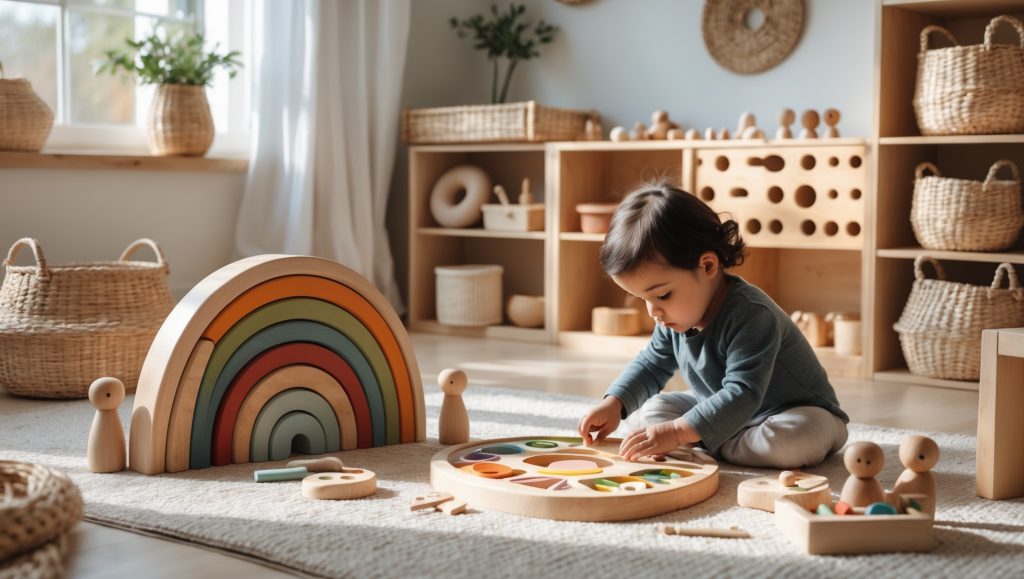
How We Chose
Our selection of Montessori-inspired toys for 2025 is grounded in principles of self-directed learning, open-ended play, and developmental appropriateness. We prioritized toys that are made with safe, natural materials, support hands-on exploration, and foster independence. Each pick was evaluated based on durability, versatility, age range, and alignment with Montessori pedagogy. We also considered real-world parent feedback and the latest research on play-based learning in U.S. homes.
#1 Lovevery Play Kits — All-in-One Montessori Subscription
Why it stands out
Lovevery’s Play Kits deliver age-tailored toys every two to three months, taking the guesswork out of Montessori-inspired play at home. Each kit contains a variety of thoughtfully designed, high-quality materials that evolve with your child’s needs.
Best for
- Parents seeking convenience and developmental guidance
- Families with infants to preschoolers (0–4 years)
Key notes
- Age/Stage: Birth to 4 years
- Materials/Ingredients: Sustainably sourced wood, organic cotton, safe plastics
- Strengths: Expert curation, diverse activities, guidance cards
- Trade-offs: Ongoing subscription cost
#2 Grimm’s Wooden Rainbow Stacker — Open-Ended Building Classic
Why it stands out
This iconic stacker invites endless creativity, from color sorting to imaginative building. Its simple design encourages children to explore size, balance, and spatial reasoning—key Montessori concepts.
Best for
- Toddlers and preschoolers who love construction play
- Families looking for a visually appealing centerpiece toy
Key notes
- Age/Stage: 1–6 years
- Materials/Ingredients: FSC-certified wood, non-toxic water-based stains
- Strengths: Durable, versatile, heirloom quality
- Trade-offs: Higher price point
#3 Guidecraft Montessori Object Permanence Box — Early Cognitive Skill Builder
Why it stands out
This simple wooden box with a ball promotes the concept of object permanence and hand-eye coordination. It’s a Montessori staple for infants eager to understand cause and effect.
Best for
- Babies ready for purposeful hand movements
- Caregivers introducing first Montessori materials
Key notes
- Age/Stage: 6–12 months
- Materials/Ingredients: Solid wood, smooth finish
- Strengths: Focused skill-building, compact
- Trade-offs: Limited use period, single function
#4 Hape Pound & Tap Bench — Multi-Sensory Exploration
Why it stands out
This toy blends music, movement, and problem-solving. Children can hammer balls through holes and watch them roll down a xylophone, discovering sound and cause-effect relationships.
Best for
- Active toddlers who enjoy hands-on play
- Families seeking toys for fine and gross motor skills
Key notes
- Age/Stage: 1–3 years
- Materials/Ingredients: Sustainable wood, water-based paints
- Strengths: Multi-use, encourages persistence
- Trade-offs: Can be noisy, supervision recommended
#5 Manhattan Toy Skwish — Grasping and Sensory Discovery
Why it stands out
The Skwish’s unique design allows it to compress and return to shape, making it irresistible for curious hands. Its elastic strings, wooden rods, and gentle rattle support early sensory and motor development.
Best for
- Infants beginning to reach and grasp
- Parents wanting a portable, easy-to-clean toy
Key notes
- Age/Stage: 0–12 months
- Materials/Ingredients: Sustainable rubberwood, elastic
- Strengths: Lightweight, engaging, safe for mouthing
- Trade-offs: Not as open-ended for older children
#6 PlanToys Solid Drum — First Musical Exploration
Why it stands out
Music is integral to Montessori environments. This solid drum offers a gentle tone, perfect for little hands learning about rhythm, listening, and coordination.
Best for
- Toddlers exploring sound and cause-effect
- Families introducing musical instruments early
Key notes
- Age/Stage: 18 months+
- Materials/Ingredients: PlanWood (recycled rubberwood), non-toxic dyes
- Strengths: Sustainable, sturdy, pleasing sound
- Trade-offs: Simple function, not adjustable in pitch
#7 Melissa & Doug Geometric Stacker — Sorting and Sequencing
Why it stands out
This classic stacker helps children practice sorting by shape, size, and color. Its chunky pieces are ideal for developing fine motor skills and logical thinking.
Best for
- Preschoolers learning early math concepts
- Families seeking affordable Montessori-style toys
Key notes
- Age/Stage: 2–4 years
- Materials/Ingredients: Solid wood, child-safe finishes
- Strengths: Versatile, encourages sequencing
- Trade-offs: Pieces can get lost, less appeal for older kids
#8 Raduga Grez Wooden Fruits & Vegetables — Realistic Pretend Play
Why it stands out
Beautifully crafted wooden produce sets invite children to engage in realistic, open-ended food play—a natural extension of Montessori practical life activities like slicing, sorting, and market play.
Best for
- Children interested in pretend cooking and shopping
- Families looking for open-ended play with natural materials
Key notes
- Age/Stage: 2–6 years
- Materials/Ingredients: Solid wood, non-toxic paint
- Strengths: Encourages real-world skills, aesthetic appeal
- Trade-offs: Not suitable for water play, higher cost
#9 Small Foot Motor Skills Cube — All-in-One Activity Center
Why it stands out
This compact cube offers bead mazes, shape sorting, and spinning gears. It supports fine motor skills, problem-solving, and independent discovery, all in a tidy footprint.
Best for
- Families with limited space
- Children who enjoy variety in play
Key notes
- Age/Stage: 1–3 years
- Materials/Ingredients: FSC-certified wood, water-based paint
- Strengths: Space-saving, multiple activities
- Trade-offs: May be overstimulating for some, heavier to move
#10 Montessori Services Practical Life Tools — Real Tools for Little Hands
Why it stands out
From child-sized brooms to safe kitchen peelers, these authentic tools empower children to participate in real household tasks, fostering independence and self-confidence.
Best for
- Preschoolers eager to help at home
- Parents wanting to integrate Montessori routines
Key notes
- Age/Stage: 2–6 years (with supervision)
- Materials/Ingredients: Wood, metal, cotton (varies by tool)
- Strengths: Promotes life skills, durable, purposeful
- Trade-offs: Requires adult supervision, some tools sold separately
Buying Tips
When selecting Montessori-inspired toys, prioritize quality over quantity. Look for items made with natural materials, as they provide richer sensory experiences and tend to be more durable. Choose toys that support your child’s current interests and developmental stage, rather than focusing on age alone. Avoid overly complex or battery-operated toys—simple, open-ended materials allow for deeper engagement and creativity. If budget is a concern, consider versatile items that can be used in multiple ways or across age ranges, and don’t overlook the value of secondhand finds.
Verdict
Montessori-inspired toys offer lasting value by supporting your child’s natural curiosity and independence. From open-ended classics like the Grimm’s Rainbow to practical life tools that invite real-world participation, each item on our list encourages meaningful, hands-on learning. Whether you opt for a curated subscription or build your collection piece by piece, investing in a few thoughtfully chosen toys can make a world of difference in your family’s play environment. Remember, the goal isn’t to fill your home with toys, but to provide purposeful materials that empower children to explore and grow at their own pace.
FAQ
+Are Montessori toys suitable for all children?
+Why are natural materials preferred in Montessori toys?
+How many Montessori toys does my child need?
+Can I introduce Montessori toys if my child attends a traditional daycare?
+Are these toys safe for mouthing and teething?
+What if my child loses interest in a toy quickly?
+Can siblings of different ages use the same Montessori toys?
+Where can I find affordable Montessori toys?

Montessori-inspired toys continue to be a top choice for parents and educators seeking to foster independence and creativity in children. In 2025, the trend is moving toward thoughtfully designed toys that support hands-on learning and self-direction. These toys typically feature natural materials, simple aesthetics, and open-ended possibilities, encouraging children to explore and problem-solve at their own pace. From wooden stacking blocks to sensory bins and practical life tools, each selection is crafted to nurture fine motor skills, concentration, and confidence. The best Montessori toys are those that grow with your child, offering new challenges as skills develop. Choosing from the top 10 Montessori-inspired toys this year means investing in your child’s ability to play independently, think critically, and enjoy learning. Parents in the US are discovering that these toys not only entertain but also help lay the groundwork for lifelong curiosity and resilience. By providing the right environment and materials, you empower your child to take charge of their play and learning, making every moment both fun and meaningful.
- Encourages self-directed learning and exploration
- Supports fine motor skill development
- Made from safe, sustainable materials
- Promotes creativity and problem-solving
If my child is sensitive to certain sounds, would the Hape Pound and Tap Bench be too overwhelming, or is there a way to adjust the play to make it more comfortable for them?
It’s thoughtful of you to consider your child’s sound sensitivity when choosing toys. The Hape Pound and Tap Bench does make musical sounds that some children might find overwhelming. To help, you can: 1) Introduce the toy gradually, letting your child touch it without making sounds at first; 2) Muffle the sound by placing a soft cloth over the xylophone or using softer mallets; 3) Play together and watch for signs of discomfort, pausing as needed; 4) Offer noise-cancelling headphones if your child is very sensitive. Always supervise play to ensure safety. This isn’t medical advice; if you’re concerned, check in with your pediatrician.
For parents working with smaller play spaces, do you find open-ended toys take up more room or less compared to sets of educational toys? I’m trying to balance encouraging creativity without overcrowding our living area.
You’re thoughtful to consider both creativity and space when choosing toys. Open-ended toys like building blocks or scarves often take up less room than large, themed educational sets because a single set can be used in many ways. Try rotating a few core open-ended toys rather than keeping everything out at once, and use baskets or low shelves for easy access and tidy storage. For toddlers and preschoolers, choose items with safe, smooth edges and non-toxic materials. This isn’t medical advice; if you’re concerned, check in with your pediatrician.
If I want to keep our play area clutter-free, do you have suggestions for rotating Montessori-inspired toys like the Lovevery Play Kits so my child stays interested without feeling overwhelmed by too many options at once?
You’re thoughtful to want a clutter-free space that supports your child’s focus. Try setting out just 4–6 Montessori-inspired toys at a time, storing the rest out of sight. Rotate these toys every week or two, watching which ones your child enjoys most and swapping in new options as interests shift. Use low baskets or shelves so toys are visible and accessible. For safety, choose age-appropriate toys without small parts or choking hazards, and supervise play, especially with new materials. This isn’t medical advice; if you’re concerned, check in with your pediatrician.
For parents on a tighter budget, do you think it’s better to invest in a single high-quality item like the Grimm’s Wooden Rainbow Stacker or try a few of the less expensive options from the list?
Your question about balancing quality and budget is such a thoughtful one. If your child is under three, a single high-quality toy like the Grimm’s Wooden Rainbow Stacker can be a wonderful long-term investment—safe, durable, and open-ended for many ages. But choosing two or three less expensive Montessori-inspired toys can also invite variety and flexibility in play. Consider your child’s interests and developmental stage, and always supervise play with small parts for younger children. This isn’t medical advice; if you’re concerned, check in with your pediatrician.
How much daily independent play with toys like the ones you recommend is ideal for a 4-year-old, especially when also balancing screen time and outdoor play? I want to set realistic limits without making playtime feel like a chore.
It’s wonderful that you want to support balanced play for your 4-year-old. At this age, aim for about 30–60 minutes of independent play with Montessori-inspired toys each day, ideally in shorter, child-led sessions. You might set up a choice of 2–3 activities and let your child pick, rotate toys weekly to keep interest, and use a visual timer so limits feel predictable, not forced. Balance this with daily outdoor play and keep screen time within recommended limits for preschoolers (usually under 1 hour a day). Remember, follow your child’s cues—play should stay joyful and pressure-free. This isn’t medical advice; if you’re concerned, check in with your pediatrician.
My child sometimes struggles with loud or unexpected noises. Is the Hape Pound & Tap Bench adjustable in terms of sound level, or are there quieter alternatives on your list that still offer similar developmental benefits?
It’s understandable to want toys that match your child’s sensory needs. The Hape Pound & Tap Bench isn’t adjustable for volume—when the balls drop and xylophone is played, it can be a bit loud for sensitive kids. For a quieter alternative, consider Montessori-style stacking cups or wooden shape sorters from the list. These encourage hand-eye coordination and problem-solving without making much noise. Always supervise play, especially with small parts if your child is under three. This isn’t medical advice; if you’re concerned, check in with your pediatrician.
For families living in small spaces, how would you suggest choosing between the Grimm’s Wooden Rainbow Stacker and multi-piece play kits like Lovevery’s, to avoid clutter but still keep playtime interesting?
It’s great that you’re thinking about both space and keeping playtime engaging. Start by considering which toy offers more versatility for your child’s age—Grimm’s Wooden Rainbow Stacker can be used for stacking, building, and pretend play, taking up less space. Rotate a few pieces at a time if you choose a multi-piece kit like Lovevery’s, storing the rest away. Look for compact storage options and involve your child in tidying up to keep things organized. Always check for age-appropriate sizes to prevent choking hazards. This isn’t medical advice; if you’re concerned, check in with your pediatrician.
My toddler sometimes puts toys in her mouth. I’m curious how you verified the safety of the paints and finishes used in these recommendations, especially with the Grimm’s and Hape products. Are there specific certifications parents should look for?
It’s thoughtful of you to check on toy safety, as mouthing toys is very common for toddlers. When selecting Montessori-inspired toys like Grimm’s and Hape, look for products labeled as non-toxic and finished with water-based paints. Reputable brands often meet certifications such as EN71 (Europe), ASTM F963 (USA), or CPSIA, which test for lead and harmful chemicals. Always supervise toddlers with new toys, check for small parts, and inspect surfaces for chips. This isn’t medical advice; if you’re concerned or your child has reacted to a toy, reach out to your pediatrician.
For families on a tight budget, would you recommend investing in a single high-quality wooden toy like the Grimm’s Rainbow Stacker, or opting for a subscription model like Lovevery that includes a mix of materials? Is there an advantage in terms of long-term value or developmental variety?
It’s completely understandable to want the best value and developmental benefit when choosing toys on a budget. Investing in a single, high-quality wooden toy like the Grimm’s Rainbow Stacker offers durability, open-ended play, and safety for young children, making it a versatile option that can grow with your child. However, a subscription model like Lovevery provides a rotating selection of toys for different developmental stages, offering variety and exposure to new challenges. For babies and toddlers, safety (no small parts, non-toxic materials) is key. Consider your child’s interests and how much variety they need—there’s no one right answer. This isn’t medical advice; if you’re concerned, check in with your pediatrician.
Is there a way to rotate or store these toys efficiently, especially for families with two children in different age groups? Space is tight and I don’t want toys to take over our living room.
It’s understandable to want your space organized, especially with children of different ages. Try grouping toys by age or skill level in clear bins or small baskets, labeling them for easy access. Store only a few toys from each group on a shelf, keeping the rest tucked away—then swap them out every few weeks to keep things fresh. Make sure smaller parts are kept out of reach of younger children for safety. Vertical storage, like wall shelves or over-the-door organizers, can save floor space. This isn’t medical advice; if you’re concerned, check in with your pediatrician.
For children who are very sensitive to sounds, would the Hape Pound & Tap Bench be suitable, or do you have suggestions for quieter Montessori-inspired alternatives?
It’s thoughtful to consider your child’s sound sensitivity when choosing toys. The Hape Pound & Tap Bench can be quite loud, so you might try quieter Montessori-inspired options like fabric stacking blocks, wooden shape sorters with soft edges, or sensory bins filled with rice or beans (supervised for safety). Also, look for toys made of felt or silicone, which naturally muffle sounds. For toddlers, always supervise to prevent choking hazards. This isn’t medical advice; if you’re concerned, check in with your pediatrician.
Would you recommend rotating all of these Montessori-inspired toys at once, or is there an optimal number to have out for an active toddler? Sometimes my son gets overstimulated if he has too many choices.
It’s completely understandable to want the right balance so your toddler thrives without feeling overwhelmed. For most active toddlers, having 3 to 5 Montessori-inspired toys available at a time is ideal—you can rotate in new options every week or two to keep things fresh. Store the rest out of sight, and observe which toys capture your child’s interest or skill level. Always supervise play, check for small parts, and choose toys suited to your child’s age and development. This isn’t medical advice; if you’re concerned, check in with your pediatrician.
I usually look for early morning activities that are quiet enough not to wake the rest of the house. Based on your list, which of these Montessori-inspired toys would you say are best for gentle, independent play first thing in the morning?
It’s great that you want peaceful ways for your child to play independently in the mornings. From the list, consider soft stacking blocks, felt shape puzzles, or wooden sorting trays—these are quiet, engaging, and don’t make noise when handled gently. For toddlers, a simple Montessori busy board with latches (no loose or small parts) can also be a quiet choice. Always supervise younger children and check for choking hazards. This isn’t medical advice; if you’re concerned, check in with your pediatrician.
With the popularity of open-ended building toys, how can parents tell if blocks or stackers meet current US safety standards for small parts? Are there certifications or labels we should be checking for to prevent choking risks in young children?
You’re right to prioritize your child’s safety with building toys and stackers. When choosing toys for young children, especially under age 3, always check the packaging for a label stating compliance with ASTM F963 (the US toy safety standard). Look for the ‘Not for children under 3 years’ warning and avoid toys with small detachable parts. Many safe toys also have a Children’s Product Certificate (CPC) or a CPSIA-compliant label. If unsure about a specific toy’s safety, it’s best to supervise play and consult the manufacturer or a pediatrician. This isn’t medical advice; if you’re concerned, check in with your pediatrician.
Are there certain toys from your list that work well in smaller homes or apartments where space for play is a challenge? I’d love ideas for maximizing play opportunities without clutter.
It’s great that you’re looking to support independent play even with limited space. For smaller homes or apartments, focus on Montessori-inspired toys like nesting cups, stacking blocks, or sensory baskets—these are compact, versatile, and easy to store. Choose toys that can be rotated in and out to keep play fresh and reduce clutter. Multi-use items such as wooden puzzles or busy boards can be attached to a wall or stored flat. Always ensure toys are age-appropriate, free of small parts for young children, and easy to clean. This isn’t medical advice; if you’re concerned, check in with your pediatrician.
My son gets overwhelmed by loud noises and bright colors. Would any of these toys be more calming or better suited for a toddler with some sensory sensitivities?
It’s wonderful that you’re noticing your son’s sensory needs and looking for toys that support him. From the list, look for toys made of natural wood with muted colors, as these are often less visually and audibly stimulating. Simple stacking blocks, wooden puzzles, or soft fabric toys can offer tactile play without overwhelming lights or sounds. Always check for non-toxic finishes and smooth edges for toddler safety. Supervise early play sessions to observe his responses. This isn’t medical advice; if you’re concerned, check in with your pediatrician.
My toddler is curious about everything but gets distracted easily, especially during potty training. Do any of these toys work well as a reward or help redirect attention back to toilet routines in a gentle, Montessori-consistent way?
It’s completely normal for toddlers to get distracted, especially with big milestones like potty training. To support your child, choose a simple Montessori-inspired toy from the article, such as wooden stacking rings or a sensory ball, as a reward after a successful toilet trip. Keep the toy close by, using it only during potty routines so it remains special and motivating. Give your toddler a choice between two toys—that sense of control is very Montessori. Make sure any toy is safe for your child’s age (no small parts, easy to clean). This isn’t medical advice; if you’re concerned, check in with your pediatrician.