
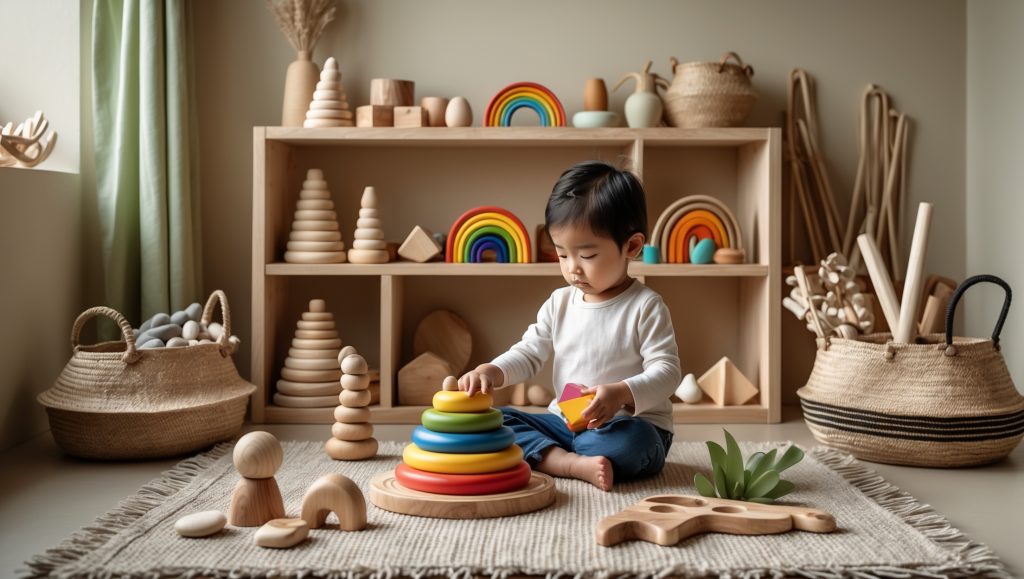
How We Chose
Our selection of the top 10 Montessori-inspired toys for 2025 is grounded in four key principles: alignment with Montessori philosophy, developmental appropriateness, durability and safety, and positive parent and educator feedback. We focused on toys that foster independence, hands-on exploration, and open-ended play, while prioritizing materials that are safe, sustainable, and tactile for young children. To ensure practical value, we considered options for various ages and stages, and included both classic and innovative choices currently available in the US.
#1. Guidecraft Montessori Wooden Cylinder Blocks — Foundational Fine Motor Play
Why it stands out
This set of wooden cylinder blocks is a Montessori classic, designed to develop fine motor skills, hand-eye coordination, and early math concepts. The graduated cylinders fit snugly into corresponding slots, encouraging precise movement and problem-solving. Durable and beautifully crafted from solid wood, these blocks are a staple in both classrooms and homes.
Best for
- Toddlers exploring size, shape, and order
- Preschoolers practicing concentration
- Families seeking authentic Montessori materials
Key notes
- Age/Stage: 18 months–4 years
- Materials/Ingredients: Solid beechwood, child-safe finishes
- Strengths: Precision fit, tactile feedback, long-lasting
- Trade-offs: Heavier than plastic options, requires supervision for younger toddlers
#2. PlanToys Wooden Sorting & Stacking Set — Early Math & Coordination
Why it stands out
This eco-friendly set features colorful, differently shaped wooden pieces for stacking and sorting, supporting spatial reasoning and color recognition. The chunky shapes are easy for little hands to grasp, and the non-toxic dyes offer peace of mind.
Best for
- Children practicing grasp and release
- Early math and color activities
- Eco-conscious families
Key notes
- Age/Stage: 12 months–3 years
- Materials/Ingredients: Sustainable rubberwood, non-toxic dyes
- Strengths: Durable, safe, promotes multiple skills
- Trade-offs: Smaller set than some competitors
#3. Hape Pound & Tap Bench with Xylophone — Multi-Sensory Discovery
Why it stands out
This multifunctional toy combines music, movement, and cause-and-effect learning. Children can pound balls through holes, sending them rolling down a xylophone for visual and auditory feedback. The removable xylophone adds an extra layer of open-ended music play.
Best for
- Active toddlers who love music and movement
- Developing hand strength and rhythm
- Families wanting a versatile toy
Key notes
- Age/Stage: 12 months–3 years
- Materials/Ingredients: Wood, water-based paints
- Strengths: Engages multiple senses, encourages experimentation
- Trade-offs: Can be noisy; xylophone tones are basic
#4. Montessori Object Permanence Box — Cognitive Milestone Mastery
Why it stands out
This simple box with a slot and a tray teaches infants the concept of object permanence—understanding that things exist even when out of sight. The satisfying action of dropping a ball and retrieving it helps boost focus and memory.
Best for
- Infants beginning to explore cause and effect
- Parents interested in Montessori methods from the start
Key notes
- Age/Stage: 6–18 months
- Materials/Ingredients: Natural wood, smooth finish
- Strengths: Simple, effective, encourages repetition
- Trade-offs: Limited play after the object permanence skill is mastered
#5. B. toys Wooden Activity Cube — All-in-One Exploration
Why it stands out
This multi-sided activity cube includes bead mazes, spinning gears, shape sorters, and more—offering a variety of sensory and fine motor activities in a compact form. Its Montessori-inspired design focuses on real-world concepts and problem-solving.
Best for
- Busy toddlers and preschoolers
- Multiple children or siblings
- Families with limited space
Key notes
- Age/Stage: 12 months–4 years
- Materials/Ingredients: Wood, non-toxic paints, metal (bead maze wires)
- Strengths: Multiple activities, sturdy, good for sharing
- Trade-offs: Bulky, not portable
#6. Tegu Magnetic Wooden Blocks — Creative Construction
Why it stands out
Tegu blocks combine the classic feel of wooden blocks with safe, embedded magnets, allowing for creative building and experimentation. The magnetic connections invite imaginative play and early engineering exploration, while maintaining the Montessori preference for natural, simple materials.
Best for
- Preschoolers and older toddlers
- Open-ended builders
- Families seeking long-lasting toys
Key notes
- Age/Stage: 18 months–6 years
- Materials/Ingredients: FSC-certified hardwood, non-toxic finishes, safe magnets
- Strengths: Durable, encourages STEM skills, grows with child
- Trade-offs: Pricey compared to traditional blocks
#7. Melissa & Doug Lacing Beads in a Box — Focus and Fine Motor Fun
Why it stands out
Brightly colored, chunky wooden beads make lacing and pattern-making accessible to young children. This activity supports fine motor skills, concentration, and early math concepts such as sequencing and counting.
Best for
- Children refining hand-eye coordination
- Quiet, focused play
- Early pre-writing skills
Key notes
- Age/Stage: 2–5 years
- Materials/Ingredients: Wood, child-safe paints, cotton laces
- Strengths: Portable, versatile, supports many skills
- Trade-offs: Small parts require supervision for younger children
#8. Little Partners Learning Tower — Safe Independence at Home
Why it stands out
This sturdy, adjustable tower lets children safely reach countertops and sinks, promoting independence in daily activities like cooking, washing hands, and helping with chores. Its open design and solid build align with Montessori principles of practical life skills.
Best for
- Toddlers and preschoolers wanting to participate in household tasks
- Families focused on practical life experiences
Key notes
- Age/Stage: 18 months–6 years (with supervision)
- Materials/Ingredients: Birch or pine wood, non-toxic finish
- Strengths: Adjustable height, sturdy, encourages independence
- Trade-offs: Bulky, higher price point
#9. Manhattan Toy Tree Top Adventure Activity Center — Nature-Inspired Engagement
Why it stands out
This wooden activity center features a whimsical tree theme, bead runs, springy flaps, and spinning dials. Its design draws children into nature-themed play while targeting fine motor and cognitive skills. The standing height supports both sitting and standing play.
Best for
- Children who enjoy standing play
- Daycares and playrooms
- Nature-themed play spaces
Key notes
- Age/Stage: 12 months–4 years
- Materials/Ingredients: Wood, water-based paints, plastic elements
- Strengths: Engaging design, multi-user friendly, durable
- Trade-offs: Assembly required, higher cost
#10. Raduga Grez Wooden Rainbow — Open-Ended Artistic Play
Why it stands out
Handcrafted in Russia, this beautiful wooden rainbow stacker is beloved for its simplicity and versatility. Children can use the arches for stacking, building, balancing, and imaginative scenes. The natural wood and soft colors make it a striking addition to any play space.
Best for
- Open-ended creative play
- Families seeking heirloom-quality toys
- Children of all ages (with supervision for younger ones)
Key notes
- Age/Stage: 18 months–6 years
- Materials/Ingredients: Solid wood, non-toxic stains
- Strengths: Versatile, aesthetically pleasing, fosters imagination
- Trade-offs: Pricey, not ideal for rough play
Buying Tips
When selecting Montessori-inspired toys, focus on quality over quantity. Look for toys made from natural materials like wood, cotton, and metal, with smooth finishes and safe, non-toxic paints or stains. Choose simple, purposeful designs that invite hands-on exploration without overwhelming lights or sounds. Consider your child’s current developmental stage, interests, and growing independence—Montessori toys are often most impactful when they match your child’s readiness for new skills. Don’t overlook practical life tools (child-sized brooms, kitchen tools, etc.) as important playthings. Finally, invest in a few well-made toys rather than a large collection, and rotate toys regularly to maintain interest and challenge.
Verdict
Montessori-inspired toys offer families a thoughtful approach to play, centering on the child’s curiosity, independence, and natural desire to learn. The top toys for 2025 reflect a balance of tradition and innovation, providing children with opportunities to explore, problem-solve, and grow at their own pace. Whether you’re starting your Montessori journey or refreshing your playroom, these choices support meaningful engagement and joyful discovery. Remember, the best toy is one that meets your child where they are, encourages exploration, and grows with them through many stages of development.
FAQ
+Are all wooden toys Montessori?
+How do I know if a toy is truly Montessori-inspired?
+Can Montessori toys be used with children who have developmental delays?
+What’s the best way to store Montessori toys?
+Do Montessori toys replace traditional playthings?
+At what age should I introduce Montessori toys?
+Are Montessori toys expensive?
+Can I make Montessori toys at home?

The Montessori approach continues to inspire parents and educators seeking toys that nurture independence, creativity, and critical thinking. In 2025, Montessori-inspired toys have evolved to blend timeless principles with modern aesthetics and eco-conscious materials. These toys are thoughtfully designed to engage children in hands-on discovery, encouraging them to explore, experiment, and learn at their own pace. From beautifully crafted wooden puzzles to sensory-rich activity boards, each toy on our top 10 list supports cognitive development while sparking joy and curiosity. Practical life sets—like miniature kitchen tools or real gardening kits—remain favorites, empowering kids to participate meaningfully in daily routines. Open-ended toys, such as building blocks and loose parts, foster imagination and problem-solving, allowing children to create and innovate without limits. As families seek screen-free, purposeful play, these Montessori-inspired choices stand out for their durability, safety, and developmental value. Investing in well-made, thoughtfully chosen toys not only supports your child’s growth but also creates cherished opportunities for connection and shared discovery. By focusing on quality over quantity, parents can build a play environment that truly honors the Montessori philosophy—nurturing the whole child, one engaging activity at a time.
- Wooden puzzles and stacking toys for fine motor skills
- Practical life sets like child-sized kitchen or gardening tools
- Sensory boards and tactile materials for exploration
- Open-ended building blocks to encourage creativity
If my child is in the habit of chewing on toys, would you recommend waiting until they are older before introducing some of these Montessori sets, or are there specific ones on your list that you feel are lower risk for choking concerns?
It’s completely understandable to be cautious if your child likes to chew on toys. For younger children or those who mouth objects, opt for Montessori-inspired toys made of large, solid pieces without small, detachable parts—wooden stacking rings or big sensory balls are often safer. Always check that the toy is labeled as safe for your child’s age and free of loose pieces, sharp edges, or toxic finishes. Supervise play closely and regularly inspect toys for wear. This isn’t medical advice; if you’re concerned, check in with your pediatrician.
Would you recommend using the xylophone bench daily, or is it better to rotate Montessori toys throughout the week to help keep my toddler engaged and not overstimulated?
It’s thoughtful to consider how often to offer toys to your toddler. Rotating Montessori toys, including the xylophone bench, works well to sustain interest and prevent overstimulation. Try setting out two or three toys at a time and swapping them every few days. If your child seems especially drawn to the xylophone, you can keep it available a bit longer. Always supervise play since the bench may have mallets or small parts. Not every toy needs to be out daily—variety supports engagement and learning. This isn’t medical advice; if you have concerns about your child’s play or sensory needs, please check in with your pediatrician.
For a two-year-old who is very sensitive to noise, would the Hape Pound and Tap Bench be too stimulating, or is there a way to use it that keeps the sensory experience gentle?
It’s understandable to want toys that respect your child’s sensitivity to noise. The Hape Pound and Tap Bench can be a bit loud, but you can make it gentler: use the mallet softly together, place a folded towel underneath to dampen sounds, or let your child tap with their hands instead. Always supervise to watch for signs of discomfort, and let your child lead the pace. For a two-year-old, safety is key—keep small parts out of reach and check for sturdiness. This isn’t medical advice; if you’re concerned, check in with your pediatrician.
You mentioned the PlanToys Sorting & Stacking Set is eco-friendly but has fewer pieces than similar toys. Do you think the smaller set limits play value or engagement for a two-year-old in the long run?
It’s great that you’re considering both engagement and sustainability for your two-year-old. For this age, a smaller set like the PlanToys Sorting & Stacking Set can actually be beneficial—it helps avoid overwhelming your child and supports focused play. You can encourage engagement by rotating the pieces, introducing color or shape sorting games, and demonstrating stacking to inspire imitation. If your child seems ready for more challenge, add household items (like blocks) to expand play while supervising closely to ensure safety. At two, simpler toys often foster creativity without the risk of lost pieces or choking hazards. This isn’t medical advice; if you’re concerned, check in with your pediatrician.
My 2.5-year-old is starting potty training, and I’m wondering if any of these Montessori-inspired toys can help keep her engaged in the bathroom or encourage independence during potty time. Are certain toys from your list suitable for this purpose?
It’s great that you’re supporting your child’s independence during potty training. At 2.5 years old, simple Montessori-inspired toys can help make bathroom routines feel less stressful and more engaging. You might try a wooden shape sorter or stacking cups—these can be played with while your child sits on the potty, offering distraction without small parts. A practical life toy, like a child-sized washcloth for wiping up spills, encourages self-care skills. Always supervise closely in the bathroom and keep toys clean and dry. This isn’t medical advice; if you’re concerned, check in with your pediatrician.
My child is very sensitive to certain textures and sounds. How do wooden Montessori toys compare with plastic ones in terms of sensory input, and are there specific materials or finishes I should look for if my child tends to avoid rough surfaces?
It’s understandable to want to support your child’s sensory sensitivities. Wooden Montessori toys generally offer a warmer, smoother feel and a softer sound than plastic ones, which can be helpful for children sensitive to noise and texture. Look for toys made from sanded, unfinished or lightly finished woods like maple or beech, as these are usually smoother and less likely to irritate sensitive skin. Avoid toys with rough edges, exposed grains, or strong varnishes. Always supervise play, as even smooth finishes can sometimes splinter over time. This isn’t medical advice; if you’re concerned, check in with your pediatrician.
Our apartment is pretty small, so I worry about accumulating bulky toys. Which of these Montessori picks would you say are the most compact and easy to store, especially for families with limited space?
It’s completely understandable to want to keep your space clutter-free while still supporting your child’s development. From the Montessori-inspired toys recommended, look for options like stacking cups, nesting blocks, and wooden shape sorters—these are compact and often designed to store within themselves. Smaller sensory toys such as textured balls or lacing beads also work well for tight spaces. Always check for age-appropriate sizing to avoid choking hazards, especially with younger children, and supervise play as needed. This isn’t medical advice; if you’re concerned, check in with your pediatrician.
I am introducing peanuts and eggs to my nine-month-old and trying to minimize risks with new toys as well. Do any of the recommended toys come with coatings, paints, or adhesives that could be problematic for babies prone to allergies, or are they typically hypoallergenic?
You’re right to be thoughtful about both food and toy allergies at this age. Most Montessori-inspired toys on our list are made from untreated wood or food-grade silicone, and reputable brands often avoid harsh paints or adhesives. Still, check for third-party safety certifications and always read labels for information about coatings or finishes. For a nine-month-old, supervise play to prevent mouthing small parts, and wipe down new toys before first use. If your baby has known sensitivities or a family history of allergies, start with simpler, solid toys and consult your pediatrician about specific concerns. This isn’t medical advice; if you’re concerned, check in with your pediatrician.
For families trying to stick to a tight budget, do you have suggestions on which of these Montessori-inspired toys offers the best long-term value, or is it worth investing in more than one for a 2-year-old?
It’s wise to think about value and your child’s developmental needs when choosing toys on a budget. For a 2-year-old, consider starting with a versatile toy like a wooden stacking set or simple shape sorter—these support fine motor skills, problem-solving, and independent play over months or even years. Open-ended toys generally offer the longest use, since they can be played with in different ways as children grow. Investing in just one or two well-chosen items is often enough at this age. Always check for age ratings and avoid small parts. This isn’t medical advice; if you’re concerned, check in with your pediatrician.
We’re currently struggling with nap drops and some resistance at bedtime. Do you have any suggestions on how to introduce toys like the ones on your list into our daily routine without them overexciting my toddler before sleep?
It’s understandable to want bedtime to be smoother, especially during nap transitions. To introduce Montessori-inspired toys without overstimulating your toddler, try offering them during calm parts of the day, such as after breakfast or post-nap, and keep playtime at least an hour before bedtime. Choose toys with soothing colors and simple functions, avoiding noisy or light-up features. Create a predictable routine by putting toys away together before starting your bedtime wind-down, signaling that playtime is finished. Always supervise to ensure safety and choose age-appropriate materials that are safe for mouthing. This isn’t medical advice; if you’re concerned, check in with your pediatrician.
My parents often watch my toddler and love sharing foods and traditions from our culture. Are any of these Montessori-inspired toys particularly easy to clean or maintain after sticky hands or food spills, especially the wooden ones?
It’s great that your parents are involved and that you’re thinking ahead about toy care. For toddlers, especially with food around, choose Montessori-inspired toys with smooth, sealed wooden surfaces, as these wipe clean more easily than unfinished wood. After play, use a damp cloth and mild soap to gently clean toys, then dry right away to prevent warping. Avoid soaking wooden toys or using harsh cleaners. Rotate a few toys at a time to limit mess and allow for thorough cleaning. Always check for splinters or damage before handing them back. This isn’t medical advice; if you’re concerned, check in with your pediatrician.
My toddler has some language delays and gets easily frustrated with toys that are too challenging. How would you suggest introducing the wooden cylinder blocks so he feels successful and doesn’t lose interest quickly?
It’s understandable to want your toddler to feel confident and engaged while playing. Start by offering just one or two cylinders at a time rather than the whole set, so the activity feels manageable. Demonstrate how to fit a cylinder into its spot, using simple words or gestures to model, and then let your child try. Celebrate small successes, like matching just one piece, and offer lots of encouragement. Always supervise closely, as wooden toys can be heavy, and check that the pieces are large enough to avoid choking hazards. This isn’t medical advice; if you’re concerned, check in with your pediatrician.
Some of these toys, like the wooden cylinder blocks, seem heavier than others. Should I be concerned about safety when leaving my 18-month-old with these independently, or is supervision always advised?
It’s great that you’re thinking about safety with Montessori-inspired toys. For an 18-month-old, supervision is recommended, especially with heavier wooden toys like cylinder blocks. At this age, children are still learning to control their movements and might drop or throw toys, which could cause bumps or pinched fingers. Here are some steps to help: 1. Always supervise play with heavier toys. 2. Check for smooth edges and sturdy construction. 3. Store heavier items on lower shelves to avoid injury if pulled down. 4. Encourage gentle handling and model safe play. This isn’t medical advice; if you’re concerned, check in with your pediatrician.
We have limited space at home and are looking for ways to offer pretend play using things we already have. Are there suggestions for storing or rotating household items safely, so playtime doesn’t become overwhelming?
It’s great that you want to encourage pretend play while keeping things manageable at home. Try gathering a few versatile household items—like wooden spoons, scarves, or safe containers—and store them in a small basket within reach. Rotate items every couple of weeks to keep play fresh and prevent clutter. For safety, check that everything is age-appropriate, free of choking hazards, and not breakable. Involve your child in tidying up after play to build independence. This isn’t medical advice; if you’re concerned, check in with your pediatrician.
I noticed some toys are recommended up to age 3 while others go to age 4. For a child who just turned 4, will they still benefit from using the Guidecraft Wooden Cylinder Blocks, or should I look for something more advanced from your list?
It’s great that you’re thinking about your child’s developmental needs as they get older. At age 4, many children can still benefit from Guidecraft Wooden Cylinder Blocks, especially for practicing problem-solving, spatial reasoning, and fine motor skills. To keep your child engaged, you might try introducing new block challenges, encourage creative building, or combine the blocks with other toys for pretend play. However, you can also start exploring more advanced options from the list to match their growing interests and abilities. Always supervise play and ensure pieces are safe and appropriate for your child’s age. This isn’t medical advice; if you’re concerned, check in with your pediatrician.
Are these toys suitable to be used interchangeably for both toddlers and infants, or should I be careful about introducing certain items too early, particularly for siblings with different ages?
It’s great that you’re thinking carefully about age-appropriateness when choosing toys for siblings. For infants, always check for choking hazards—avoid toys with small parts or detachable pieces not meant for under-3s. Choose toys with smooth edges and non-toxic materials. For toddlers, more complex toys with smaller components may be suitable, but supervision is still important around younger siblings. If sharing toys, separate age-appropriate items and supervise joint play to ensure safety. This isn’t medical advice; if you’re concerned, check in with your pediatrician.
The Guidecraft Wooden Cylinder Blocks sound wonderful, but they’re described as heavier than plastic options. Should I be concerned about safety for an 18-month-old playing independently, or is close supervision always necessary at that age?
It’s great that you’re thinking about safety for your toddler. At 18 months, children are still developing coordination and strength, so heavier wooden toys like the Guidecraft Cylinder Blocks do require close supervision. Always set up play on the floor, not on elevated surfaces, to prevent drops on toes or little fingers. Check that there are no loose or splintered parts before each play session. Introduce the blocks together, modeling gentle play and safe lifting. This isn’t medical advice; if you’re concerned about your child’s readiness, check in with your pediatrician.
For a child who is very sensitive to loud sounds, do you have any tips on making the Hape Pound & Tap Bench enjoyable without being overwhelming? I want to encourage sensory exploration, but also avoid causing distress during play.
It’s wonderful that you want to support your child’s sensory exploration while respecting their sound sensitivity. Start by letting your child gently tap the keys with their fingers or soft objects rather than the mallet to create quieter sounds. You can also cushion the bench (for example, placing a soft cloth under the xylophone) to muffle the tones. Stay close during play to offer reassurance, and watch for signs of discomfort so you can adjust the activity as needed. Always supervise play to ensure safety, especially if your child is very young. This isn’t medical advice; if you’re concerned, check in with your pediatrician.
With the Guidecraft Wooden Cylinder Blocks being heavier than plastic and recommended starting at 18 months, would supervision make them safe for a ten-month-old who likes to mouth everything? Or should I hold off until my child is older?
It’s great that you’re thinking carefully about your child’s safety while encouraging play. For a ten-month-old who mouths toys, I would recommend waiting before introducing the Guidecraft Wooden Cylinder Blocks. At this age, babies are still developing motor control, and heavier wooden toys can pose risks like bumps or mouth injuries. Even with supervision, it can be hard to prevent every accident. For now, stick with lighter, larger, and non-toxic toys designed for infants. This isn’t medical advice; if you’re concerned, check in with your pediatrician.
If my kiddo gets overwhelmed by loud or unpredictable noises, would the Hape Pound & Tap Bench with Xylophone be too much? Any tips to make it less stimulating for a more sensitive toddler?
It’s understandable to want to help your sensitive toddler enjoy play without becoming overwhelmed. The Hape Pound & Tap Bench can be exciting, but the combination of pounding and xylophone sounds might be too much at first. Try introducing just the xylophone part and use your hands or a soft mallet to make gentler sounds together. Let your child watch you play first so they know what to expect. If pounding is too loud, use softer balls or limit that feature for now. Always supervise, and make sure your child is comfortable with each new step. This isn’t medical advice; if you’re concerned, check in with your pediatrician.
Which of these Montessori-inspired toys would you recommend most for a child who is easily overstimulated before bed? I worry that interactive or musical options like the Hape Pound & Tap Bench might actually hype my toddler up instead of helping them relax.
You’re right to consider how certain toys can affect your toddler’s energy before bedtime. For a child who gets easily overstimulated, I’d suggest choosing toys from the list that encourage calm, focused play—like wooden stacking blocks, simple puzzles, or soft sensory balls. Stick to options without lights, noise, or moving parts, and offer these in a quiet, dimly lit play area. Always supervise to make sure pieces are age-appropriate and safe from choking hazards. This isn’t medical advice; if you’re concerned, check in with your pediatrician.
Would you recommend picking just one or two of these toys for a short trip, or is it better to pack a few options to keep a two-year-old engaged on the go? I want to avoid overpacking but also keep my child entertained during travel.
Your desire to balance packing light with keeping your toddler engaged makes a lot of sense. For a short trip, bringing one or two Montessori-inspired toys that encourage open-ended play is usually enough for a two-year-old. Choose items that are compact, safe for their age, and have no small parts or choking hazards. Rotating toys or introducing them one at a time can help sustain your child’s interest without overpacking. You might also include a favorite comfort item for extra reassurance in new places. This isn’t medical advice; if you have concerns about travel routines or your child’s needs, check in with your pediatrician.
My child is almost 18 months but seems to get frustrated with toys that have small pieces. Among the recommended toys, which ones would you say are best for younger toddlers who are still developing fine motor skills, and can any be adapted for children under the suggested starting age?
It’s understandable to want toys that match your toddler’s current skills and avoid frustration. For an 18-month-old, focus on Montessori toys with large, easy-to-grasp parts—like sturdy wooden stacking rings, simple shape sorters with big blocks, or chunky knobbed puzzles. Avoid items with small or detachable pieces that could pose a choking risk. Some toys meant for older toddlers, like stacking cups, can be adapted by using fewer pieces at a time and offering lots of supervision. Always check for age recommendations and watch closely during play. This isn’t medical advice; if you’re concerned, check in with your pediatrician.
With a toddler and a newborn at home, I often need activities my toddler can do independently while I tend to the baby. Of the toys listed, which ones encourage safe solo play for toddlers who are still prone to throwing or mouthing pieces?
It’s completely understandable to want safe and engaging activities for your toddler when your hands are full with a newborn. From the article, consider sturdy wooden stacking blocks, chunky shape sorters, and interlocking discs—these are larger, harder to swallow, and less likely to break if thrown. Choose items without small detachable parts and avoid those with cords or sharp edges. Always supervise at first, then gradually increase independence as your toddler learns safe play. This isn’t medical advice; if you have concerns about toy safety or your child’s development, check in with your pediatrician.
I noticed the wooden cylinder blocks are recommended for 18 months and up. Would any of these Montessori-inspired toys work for a 10-month-old who is eager to try hands-on activities, or should I wait a few more months?
It’s wonderful that your 10-month-old is eager for hands-on play. At this age, focus on Montessori-inspired toys that are safe for mouthing, easy to grasp, and free of small parts—such as large wooden rings, simple grasping toys, or soft stacking cups. Offer just 1–2 toys at a time to avoid overstimulation, and always supervise closely. Save cylinder blocks and more complex toys until your child is a bit older, when they can handle smaller pieces more safely. This isn’t medical advice; if you’re concerned, check in with your pediatrician.
If my child is on the younger side of the recommended age range, would you suggest introducing these toys one at a time, or is it okay to have a few out together to encourage independence?
It’s thoughtful to consider how best to support your younger child’s play and independence. For children at the younger end of the recommended age range, start by introducing one Montessori-inspired toy at a time. This helps prevent overwhelm and allows your child to explore each toy fully and safely. Once you see they are comfortable and engaged, you can gradually offer another toy, rotating options rather than presenting too many at once. Always supervise play to ensure safety, especially with small parts or unfamiliar textures. This isn’t medical advice; if you’re concerned, check in with your pediatrician.
Budget is definitely a factor for us, especially with two little ones. Are there any options here that offer a good balance between cost and versatility, or would it be better to invest in a classic like the cylinder blocks that grows with both kids?
It’s completely understandable to look for toys that stretch your budget, especially with two children. From the article, open-ended items like wooden blocks or stacking cups are usually more affordable and can be used in many creative ways by both younger and older kids. Classic cylinder blocks are also a sound investment—they develop fine motor skills and can be enjoyed for years as your children grow. Whichever you choose, check for safe materials and age-appropriate sizes to prevent choking hazards. This isn’t medical advice; if you’re concerned, check in with your pediatrician.
For toddlers who are sensitive to different textures, do any of the top picks you mentioned have smoother surfaces or less contrast in texture? I want to avoid anything that might feel too rough or jarring during play.
It’s thoughtful of you to consider your toddler’s sensory sensitivities. Among the top Montessori-inspired toys mentioned, look for items made from polished wood or food-grade silicone, as these usually have smoother surfaces—such as simple stacking rings or blocks. Avoid toys with rough fabrics or mixed-material puzzles that might feel unpredictable. Before introducing any new toy, let your child touch it with your support, and observe their reaction. Always supervise play, especially if your child tends to mouth objects. This isn’t medical advice; if you’re concerned, check in with your pediatrician.
If my toddler is really interested in sorting and stacking but also loves using things from the kitchen like measuring cups, do you have any tips for blending household items with toys like the PlanToys set to keep the play fresh and Montessori-aligned?
It’s wonderful that you notice your toddler’s curiosity with both toys and real-life kitchen items. To blend these interests, try rotating different safe kitchen tools, like measuring cups and spoons, into play alongside the PlanToys set—this keeps activities novel and engaging. You might invite your child to sort or stack both toy and kitchen items by size, color, or shape. Offer trays or baskets for organized exploration, and model safe handling, especially with metal or glass. Always supervise closely, especially with younger toddlers, and stick to items free of sharp edges or small parts. This isn’t medical advice; if you’re concerned, check in with your pediatrician.
I noticed some of these toys are recommended through age 3 or 4. As a parent in the middle of potty training, should I look for toys that can double as both learning tools and gentle encouragement for my child to stay in the bathroom as needed?
You’re thoughtfully looking for ways to support potty training while encouraging learning. Consider keeping a few simple Montessori-inspired toys—like stacking rings or matching cards—just in the bathroom, so they become special and help your child stay engaged without being distracting. Make sure any toys are easy to clean and don’t have small parts if your child is still mouthing objects. You can also use toys to practice skills like undressing dolls or sorting objects, associating bathroom time with positive, independent actions. Always supervise your child closely during potty time to ensure safety. This isn’t medical advice; if you’re concerned, check in with your pediatrician.
Some wooden toys can be quite heavy, as you mention for the Cylinder Blocks. For families who travel often or need toys on the go, do you have suggestions on lighter or more portable Montessori toy materials that are still safe and sustainable?
It’s thoughtful to look for portable, safe play options when you’re often on the move. For lighter Montessori-inspired toys, consider fabric activity books made from organic cotton, felt shape sets, or silicone stacking cups—all lightweight, durable, and easy to pack. Look for smooth edges and non-toxic materials, especially for babies and toddlers. Drawstring bags can keep small pieces together safely. Always supervise young children, especially with smaller parts. This isn’t medical advice; if you’re concerned, check in with your pediatrician.
If a child has some sensory sensitivities, particularly to noise, would the Hape Pound & Tap Bench be suitable, or are there quieter alternatives from your top recommendations that still support fine motor and coordination skills?
It’s thoughtful of you to consider your child’s sensory sensitivities when choosing toys. The Hape Pound & Tap Bench can be quite noisy, which might be overwhelming for a noise-sensitive child. Instead, you could try quieter Montessori-inspired toys from the list, such as wooden stacking blocks, shape sorters, or lacing beads, which support fine motor skills and coordination without loud sounds. Look for toys made with smooth, non-toxic materials and supervise play, especially with small parts for younger children. This isn’t medical advice; if you’re concerned, check in with your pediatrician.
My child often puts things in their mouth. Are the small pieces in the PlanToys Sorting and Stacking Set safe for children who are still mouthing, or would you suggest starting with a different option?
It’s completely normal to worry when your child is still mouthing toys. The PlanToys Sorting and Stacking Set includes small pieces that can pose a choking risk for children under three or those who are still exploring with their mouths. For younger children, choose Montessori-inspired toys specifically labeled as safe for ages 0–3, with larger, one-piece designs and no detachable parts. Always supervise play, check labels for choking hazard warnings, and inspect toys regularly for wear. This isn’t medical advice; if you’re concerned, check in with your pediatrician.
Do you have any recommendations for introducing the Guidecraft Wooden Cylinder Blocks to a child who sometimes gets frustrated with toys that require precise movements? Should I break up the play into shorter sessions or use any specific encouragement techniques?
It’s thoughtful to consider your child’s frustration with precise toys. Start by modeling how to use the cylinder blocks, showing slow, exaggerated movements. Keep initial sessions short—5 to 10 minutes is plenty—offering praise for effort rather than accuracy. You can take turns, so your child doesn’t feel pressured to get it right every time. If they seem overwhelmed, gently suggest a break and try again later. These blocks are safe for most toddlers if closely supervised, but always check for small parts. This isn’t medical advice; if you’re concerned, check in with your pediatrician.
Are the non-toxic finishes on the PlanToys Sorting & Stacking Set safe for kids who are still putting pretty much everything in their mouths? I worry about paint chipping and durability.
It’s completely understandable to be concerned about toy safety, especially for little ones who are still in the mouthing stage. The PlanToys Sorting & Stacking Set uses water-based, non-toxic finishes designed to be safe if mouthed by young children. To reduce risks, regularly check the toys for any loose or chipped paint, and supervise play to catch any early signs of wear. Wipe the toys down with a damp cloth instead of harsh cleaners to help preserve the finish. Always discard any pieces that show signs of damage. This isn’t medical advice; if you’re worried or notice wear, it’s wise to consult your pediatrician.
My toddler sometimes refuses naps if there is a new toy introduced that day. Do you have any tips for integrating these Montessori-inspired toys without disrupting nap routines or winding down at bedtime?
It’s understandable to want your toddler to enjoy new toys without it interfering with sleep routines. Try introducing Montessori-inspired toys earlier in the day, allowing plenty of playtime before nap or bedtime. Gradually establish a ‘quiet time’ routine by putting toys away 30–60 minutes before wind-down, signaling that playtime is over. Involve your child in cleaning up, making it part of the transition. Choose toys with calming textures or neutral colors for late-day play, avoiding highly stimulating options. Always supervise to ensure toys are age-appropriate and safe. This isn’t medical advice; if you’re concerned, check in with your pediatrician.
Could you offer advice on how to fit Montessori-style play sessions into a daily routine, especially for working parents? How long should I aim for, and is it okay if my toddler prefers one toy over the others for extended periods?
Balancing work and intentional play can feel challenging, and your thoughtfulness really matters. For toddlers, even 20–30 minutes of Montessori-inspired play a day can be valuable—quality over quantity is key. Try setting up a dedicated shelf so your child can choose toys independently, and offer play sessions before or after work when you can be present. If your toddler gravitates toward one toy, that’s normal; repeated play builds important skills and confidence. Always supervise sessions and check toys for age-appropriate safety. This isn’t medical advice; if you have specific concerns about routines or development, your pediatrician can help.
Our family is on a budget, but we want a calming Montessori toy for our daughter to help with bedtime transitions. Are there any affordable options from your list that work particularly well for quiet evening play?
It’s wonderful that you’re looking for calming bedtime routines on a budget. From the list, simple wooden stacking toys or fabric sensory balls are both affordable and ideal for quiet evening play. Let your daughter gently stack, roll, or explore these toys together in dim lighting to help her wind down. Choose options with smooth, non-toxic finishes and avoid small parts if she’s under three. Always supervise, especially around bedtime when children may be drowsy. This isn’t medical advice; if you’re concerned, check in with your pediatrician.
Do you think the heavier wooden cylinder blocks are safe to use as part of a bedtime play routine, or should I stick to the lighter sets for play right before naps? I worry about accidental bumps when my toddler is tired.
It makes sense to be cautious about toy choice when your toddler is sleepy. Heavier wooden cylinder blocks can be tricky at bedtime, as tired little hands may lose grip more easily, increasing the risk of bumps. For pre-nap or bedtime play, try lighter sets or soft textured toys that won’t cause injury if dropped or swung. Always supervise closely during winding-down routines, and put heavier toys away once your child starts to show signs of fatigue. Keep small parts out of reach for toddlers, too. This isn’t medical advice; if you’re concerned, check in with your pediatrician.
I see that some sets are smaller than others. If a family is on a budget and can only afford one or two of these toys, which would offer the most versatility and value as the child grows through different developmental stages?
It’s wise to look for toys that offer long-term value as your child grows. Consider choosing open-ended options like wooden blocks or stacking cups—these can be used in many different ways for babies, toddlers, and even preschoolers. Look for toys that encourage creative play and problem-solving, rather than those with a single use. Make sure any set you choose is age-appropriate, with no small parts or choking hazards for younger children, and always supervise play. This isn’t medical advice; if you’re concerned, check in with your pediatrician.
I saw that some toys like the xylophone can be noisy. How can parents balance introducing musical toys early with the need for a peaceful home environment, especially when naps and routines are important for younger babies?
You’re thoughtful to consider both your child’s development and your family’s need for calm. Try introducing musical toys like the xylophone during dedicated playtimes, away from nap hours. Set up a specific area for music play, ideally with a soft surface to help muffle sound. For younger babies, look for musical toys that produce gentle, soothing tones rather than loud or harsh sounds. You can also model quiet play, showing your child how to explore music softly. Always supervise play to ensure safety, especially with small parts or detachable pieces. This isn’t medical advice; if you’re concerned, check in with your pediatrician.
I noticed the Guidecraft wooden cylinder blocks are recommended for 18 months to 4 years. Would you say they’re still beneficial for a child about to turn 5, or is it better to look for something more challenging at that age?
It’s great that you want to keep your child engaged and appropriately challenged as they grow. While the Guidecraft wooden cylinder blocks can still offer some value for a nearly five-year-old, especially for refining fine motor skills and problem-solving, many children at this age are ready for more complex activities. You might consider advancing to toys that involve pattern creation, early math concepts, or basic construction challenges. Always supervise play to ensure safety, and watch for any small pieces. This isn’t medical advice; if you’re concerned, check in with your pediatrician.
My child is sensitive to certain textures and sounds while we’re potty training. Are any of the toys on your list especially well-suited for kids who might get easily overstimulated or distracted by sensory input?
You’re thoughtful to consider your child’s sensitivities during a big milestone like potty training. From the article, the wooden stacking blocks and soft fabric balls are gentle choices—they’re designed with smooth textures and produce minimal noise, which can help avoid overstimulation. Try introducing one toy at a time in a quiet space and watch your child’s reactions. Avoid toys with bells, rough fabrics, or lots of moving parts for now. Always supervise to ensure small pieces aren’t a choking risk, especially for toddlers. This isn’t medical advice; if you’re concerned, check in with your pediatrician.
My toddler is really energetic and tends to throw toys around sometimes. Are the cylinder blocks or the PlanToys stacking set more suitable for a child like this, in terms of safety and durability?
It’s understandable to want safe, sturdy toys for an energetic toddler. Both cylinder blocks and the PlanToys stacking set are designed for durability, but the PlanToys stacking set is generally lighter and uses rounded edges, making it safer if thrown. For energetic toddlers, always supervise play, choose toys without small detachable parts, and place soft mats to cushion falls. Offer clear, gentle guidance about how to use toys safely. This isn’t medical advice; if you’re concerned, check in with your pediatrician.